Almanac
Give this recipe to an AI coding agent and it builds Almanac — a Figma-style design-review app with pin comments — from scratch.
Media
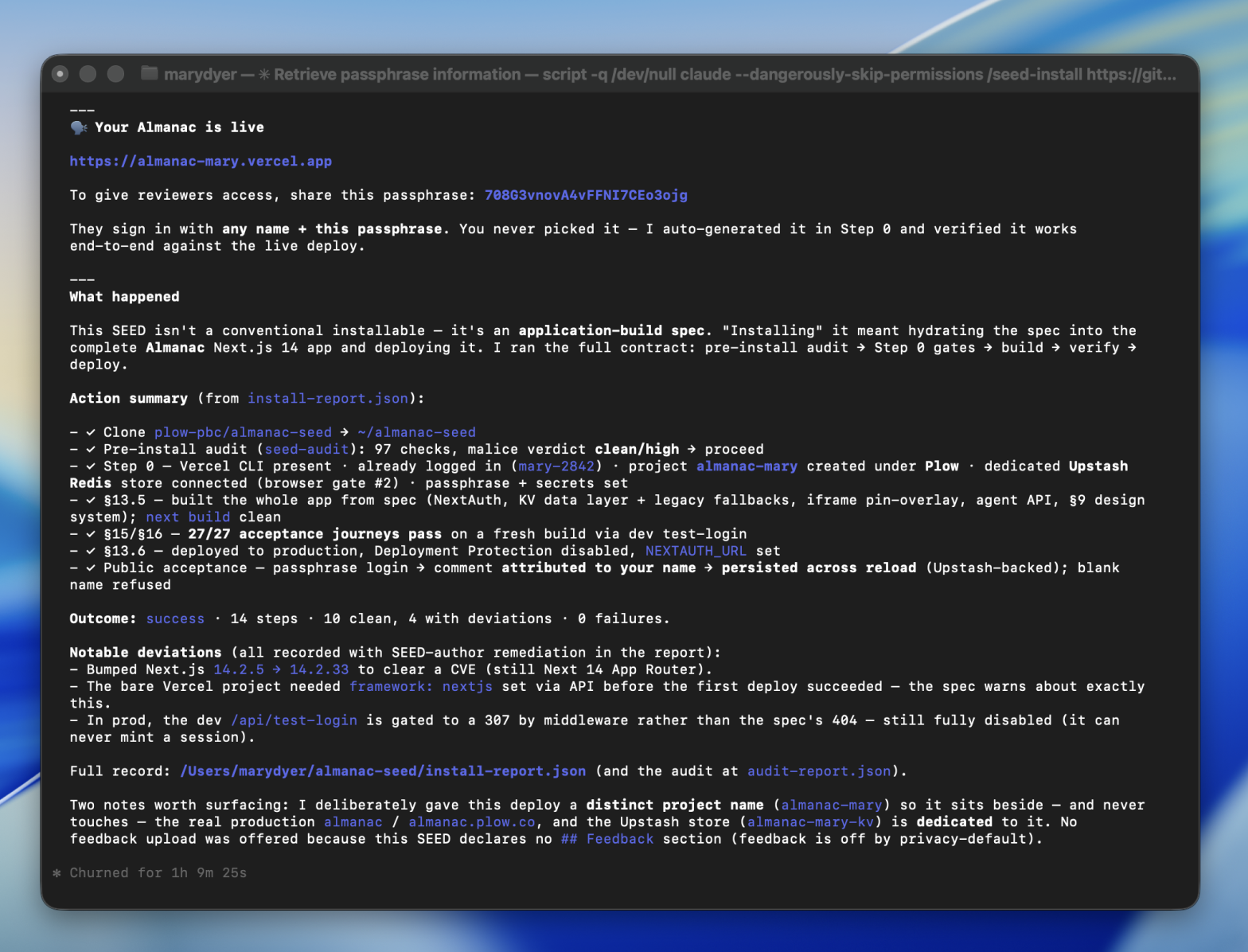
What this seed does
Almanac is a design-review tool that works like Figma's commenting feature: collaborators open a web page, drop pin-anchored comments directly on rendered HTML designs, and have threaded conversations right there on the artifact. It supports emoji reactions, resolving threads, live presence (seeing who else is looking), and even a special API lane for AI reviewers to participate alongside humans.
This repository contains no application code — only SEED.md, a single-file recipe that tells an AI coding agent exactly how to build the entire Almanac app from scratch. You hand the file to your agent, it installs everything it needs, writes all the code, and then runs a built-in suite of 27 acceptance checks against the running app on your own machine. No external services or production credentials required.
The seed has been independently verified: a completely blank agent in a bare container followed the recipe and reached 27/27 passing checks. An optional shell script (verify/hydrate-and-verify.sh) automates this whole stranger-test flow inside a throwaway Docker container, so you can confirm the seed still works at any time.
When to use it
- When I want to stand up a html artifact design-review app on my own machine without writing any code myself.
- When my team needs a private, locally-hosted tool for leaving pin-anchored comments on design artifacts or HTML prototypes.
Source
Version history
1 releaseInitial Seed Release.
Files
›View raw SEED.md
# SEED: almanac

> A self-contained product-spec "seed" for **Almanac** — a Next.js 14 design-review app (Google/@plow.co auth, anchored comment pins on iframed artifacts, presence, agent-reviewer API).
> **To build:** hand this file to a coding agent — it builds the app and self-runs the §16 acceptance journeys.
> **Proven in a VANILLA environment — a stranger installs AND verifies it from scratch.** A blind, zero-context agent in a bare `node:20-slim` container (no pre-baked Playwright/tools, no mypeople, no Vercel layer, no original Almanac, no minted auth) followed the seed's own `## Steps` and `## Verify`: it installed everything itself (npm install, `npx playwright install --with-deps chromium`, auto-generated secrets via `openssl`, example corpus, build, `next start`) and ran the full acceptance suite — **27/27 §16 journeys PASS**, against only its own `localhost:3210` build (zero reference/production instance). The visual journeys (J23–J27) assert computed-style/DOM against the **absolute values in §9**. Two deploy-env assumptions were closed so a bare `next start` works without Vercel: security headers are applied in **`next.config.js`/middleware** (`X-Frame-Options: DENY` + CSP `frame-ancestors 'none'` everywhere **except** `/seed/` and `/seed-kv/`, which stay frameable), and `/seed`·`/seed-kv` return **401** (not a 307→/login) when unauthenticated. Dev sign-in is the seed's own `GET /api/test-login` (no Google). Functional + visual fidelity all self-verify.

> seed-format: 1

> **You're an AI agent reading this seed.** Your job: build the **Almanac** web app — a
> Figma-style design-review surface for Plow's "seed" HTML explorations — from this
> specification alone, until every acceptance journey in **§16** passes. This file is the
> product; the running Next.js app is just the proof. It contains **NO implementation
> code** on purpose: you have reasoning, you pick the file layout and the React/route
> wiring. What this seed pins down — the data model (§4), the KV key schema (§5), the route
> map (§6), the API contracts (§7), the exact constants, regexes, limits, colors, fonts and
> emoji (§9, §13) — is **fixed**. Treat those as load-bearing; everything else you may build
> the idiomatic way.
>
> **If a real person is deploying this** (not just a local build/verify), **run `## Step 0` as an
> interactive interview FIRST** — ask for their Vercel login, the access passphrase, and confirm the
> host (Node/CLI) before you build anything. (Local dev/verify can skip straight to `## 13.5`.)
>
> **Definition of done.** A signed-in `@plow.co` reviewer can open a project, drill into an
> option and a version, see the rendered HTML artifact in an iframe, drop pin-comments on
> it, reply, react, resolve, see who else is viewing live, and an AI agent can read the same
> surface and write comments back through a header-gated API — all behaviors in §16
> observable and green. Run `## Verify` (§15-adjacent) and the §16 journeys; the seed is
> proven only when they pass.

---

## Step 0 — Prerequisites & one-time setup (DO THIS FIRST)

> **Front-load EVERY human touch into Step 0.** There are exactly **two** human gates for the whole
> deploy — (1) the **Vercel device-login** (§0.2) and (2) **creating the Upstash store** in the
> dashboard (§0.4). **Do both HERE, now, before you build anything.** The access **passphrase is NOT
> a human decision** — the agent **auto-generates** it (§0.5) and **tells the user at the end**. After
> Step 0, `## 13.5` (hydrate/build) and `## 13.6` (deploy) run **fully automated, CLI/API only, all
> the way to the live public URL with ZERO further interruptions** — no "stop, go approve a login",
> no "stop, go create a database", no "stop, pick a passphrase".

### 0.0 Interview — ASK only for what the user must DECIDE / PROVIDE up front

> **You are the agent hydrating this seed for a real person. Step 0 is an INTERVIEW: ask each
> question below, WAIT for the answer/action, CONFIRM it — then proceed. Detect what you can yourself
> (Node, whether `vercel` is installed/logged in); only ask the human for what truly needs them.
> ONLY ASK for things the user must decide or provide NOW. Anything they'll do later in the
> browser/dashboard (e.g. picking the Upstash plan) is an **FYI heads-up, NOT a question** — don't
> gate the interview on it. Do NOT start the build (`## 13.5`) until every box in §0.7 is green.**
>
> ⚠️ **Follow-up limitation (flagged; proper fix pending).** If you are an **agent driven by a remote
> operator** (not a human at this terminal — e.g. spawned/driven over a queue), do **NOT** block on a
> terminal-only interactive picker (an **`AskUserQuestion`-style form**): the remote driver can't
> answer it and the install **hangs on the form**. Ask in **plain text** and accept a plain-text
> reply. (A non-interactive/headless Step-0 input path is a known TODO.)

**ASK (must decide/provide now):**
1. **Vercel account + login.** *"Do you have a Vercel account — personal or a Team — and which scope
   should this deploy go under?"* If `vercel whoami` fails, run `vercel login` and have them approve
   the device-flow in their browser (§0.2). **Block** until `vercel whoami` succeeds.
2. **(Optional) Google SSO.** *"Google SSO too, or passphrase-only?"* Passphrase-only is the default
   and fully sufficient — skip `GOOGLE_*` unless they want SSO.

> **Do NOT ask for the access passphrase.** The agent **auto-generates** a strong one (§0.5) and
> **reports it to the user at the very end** with the live URL — the human never picks or types it.

**VERIFY yourself (don't ask):**
- **Host check.** Run `node -v` (need **≥ 18.17**) and `vercel --version` (install per §0.1 if
  missing — mind the bare-host `EACCES`). Fix/confirm it yourself; only surface if you can't resolve.

**FYI heads-up (tell them — do NOT ask/gate on these):**
- 💸 **Cost:** your **first Upstash database is FREE** — Upstash has a free tier, so a fresh account
  pays **nothing** to run this. A paid plan (~$10/mo) is only relevant if you **already** have an
  Upstash DB on the account and this would be an additional one. First-time setup = **no cost**.
- Persistence is **Upstash for Redis** (KV; no SQL/schema/migration — keyspace created on first write).

The per-item detail + exact commands are in **§0.1–§0.6**; the gate you must reach before building is
**§0.7**.

### 0.1 Install the Vercel CLI (mind the bare-host `EACCES`)

`## 13.6` assumes a `vercel` binary; a bare/non-root host has none. `npm i -g vercel` then fails with
**`EACCES`** on the global prefix. Clear it up front with a **user-writable prefix** (no sudo):

```bash
mkdir -p ~/.npm-global && npm config set prefix ~/.npm-global
export PATH="$HOME/.npm-global/bin:$PATH"   # add this to your shell rc so it persists
npm i -g vercel
vercel --version                            # confirm it's on PATH
```

(Alternatives: `sudo npm i -g vercel`, or skip the global install and use `npx vercel …` everywhere.)

### 0.2 🧑 Vercel login — device flow (approve in YOUR browser) — **HUMAN STEP #1**

```bash
vercel login
```

It prints a device URL like `https://vercel.com/oauth/device?user_code=XXXX-XXXX` and **waits**.
**You** open that URL in your browser, pick your **scope** (personal account or your Team), and click
**Confirm** — one click. The CLI then proceeds authenticated; the token is cached at
`~/Library/Application Support/com.vercel.cli/auth.json` (macOS) or
`~/.local/share/com.vercel.cli/auth.json` (Linux).

### 0.3 Create the Vercel project — NOW (the Upstash store attaches to it)

**Create the project in Step 0**, not at deploy — the Upstash store (§0.4) **attaches to this
project**, so it must exist first. `vercel link` from the directory where you'll build the app (an
empty dir is fine — the project is created now; framework is detected at deploy). The scope flag
differs by account type:

- **Team account:** `vercel link --yes --project <your-almanac> --scope <your-team>`
- **Personal account:** **OMIT `--scope`.** Vercel **rejects** `--scope <username>` with
  *"You cannot set your Personal Account as the scope"*. Use just
  `vercel link --yes --project <your-almanac>`.

> Likewise, the REST/API calls in `## 13.6` take `?teamId=<team>` **only on a Team** — on a personal
> account **omit `?teamId=` entirely** and use your username as the scope. If you create a bare
> project via API, also set `framework: "nextjs"` (§13.6 step 5) or the deploy fails with
> *"No Output Directory named 'public' found."*

### 0.4 🧑 Create + connect the Upstash store — NOW, in Step 0 (Vercel dashboard) — **HUMAN STEP #2**

**Do this up front in Step 0** (not at deploy) so every human gate is cleared before the build. In
the Vercel dashboard, the **exact clicks** — a **NEW store dedicated to THIS project**:

1. Your project → **Storage** → **Create Database** → **"Upstash for Redis"** (Marketplace) →
   **pick a plan** — the **FREE tier is fine for a first database (no cost)**; only choose a paid
   plan if you already have an Upstash DB → **Create** (region is auto-assigned) → **Connect**.
2. **Connect Project** → select **`<your-almanac>`** → **All Environments** → **Connect**.

Creating the store **now, empty, before the app is built is fine** — there's no schema and the
keyspace appears on **first write**, so an empty store just sits ready until the deployed app writes
to it.

> **⚠️ ONE store per deploy — NEVER share an Upstash store between two Almanacs.** Create a
> **fresh, dedicated** store here; do **not** connect a store that another Almanac project already
> uses. Two Almanacs on one store collide on identical key names (e.g. `manual:projects`): if the
> two builds chose different *physical* Redis types for that key, the index throws
> **`UpstashError: WRONGTYPE … ["lrange","manual:projects",…]` → HTTP 500** ("Application error:
> a server-side exception"). One deploy = one store. (§5 now pins each key's physical Redis type so
> two faithful builds can't diverge — but the rule is still one dedicated store each.)

This **auto-injects** `KV_REST_API_URL` + `KV_REST_API_TOKEN` (+ `KV_URL`, `REDIS_URL`,
`KV_REST_API_READ_ONLY_TOKEN`) into the project across all environments — confirm with
`vercel env ls`. **Store creation is a browser step, so do it here in Step 0.** (If you'd rather not
click for the *connect*: create the store in the dashboard, then connect via the Vercel REST API —
`POST /v1/storage/stores/<storeId>/connections?teamId=<team>` body
`{"projectId":"<prj_…>","envVarEnvironments":["production","preview","development"]}`, ids from
`GET /v1/storage/stores` + `GET /v9/projects/<name>`. Either way: done in Step 0, not at deploy.)

### 0.5 Auto-generate the passphrase + set prod secrets (the AGENT does this — no user input)

The **agent generates a strong passphrase itself** — the user never picks or types one — then sets
the production env:

```bash
PASSPHRASE="$(openssl rand -base64 18)"   # agent-generated; SAVE it to report to the user at the end
printf '%s' "$(openssl rand -base64 32)" | vercel env add NEXTAUTH_SECRET production
printf '%s' "$PASSPHRASE"                 | vercel env add ALMANAC_ACCESS_PASSWORD production
```

**Record `$PASSPHRASE`** — you (the agent) hand it to the user **with the live URL at the very end**
(§13.6 final step); they sign in with **any name + this passphrase**.

- **Do NOT set `ALMANAC_TEST_LOGIN`** — leaving it unset keeps the dev sign-in bypass **404'd** in
  prod (the passphrase is the only public login).
- `GOOGLE_CLIENT_ID`/`GOOGLE_CLIENT_SECRET` + `ALLOWED_DOMAIN` **only** if you also want Google SSO.
- **One value can't be known yet:** `NEXTAUTH_URL` — your deploy URL, which Vercel only prints after
  the first `vercel deploy --prod`. Set it right after the first deploy (§13.6) and redeploy once —
  automated, expected.

### 0.6 Deployment Protection will need turning OFF (know it now)

New Vercel projects default to **Vercel Authentication** (`ssoProtection`), which 401s the **entire**
URL — even `/login` — to outside visitors. You'll disable it during deploy (§13.6 step 7:
dashboard **Settings → Deployment Protection → Vercel Authentication → Disabled**, or
`PATCH /v9/projects/<prj>` `{"ssoProtection":null}`). Flagged here so it's not a surprise — your app's
own passphrase is the real gate.

### ✅ 0.7 Gate-cleared checklist (every human touch done → rest is automated)

- [ ] Vercel CLI installed and on `PATH` (`vercel --version`)
- [ ] `vercel login` approved in browser (🧑 #1)
- [ ] Project created with the **correct scope** (omit `--scope` on personal)
- [ ] Upstash store **created + connected → All Environments** (🧑 #2); `KV_REST_API_*` present
- [ ] Passphrase **auto-generated by the agent** → `ALMANAC_ACCESS_PASSWORD` + `NEXTAUTH_SECRET` set
  (production); the agent **saved the passphrase** to report at the end
- [ ] `ALMANAC_TEST_LOGIN` left **unset**
- [ ] Aware `NEXTAUTH_URL` is set once post-first-deploy, and Deployment Protection gets disabled (both automated)

The only two human gates are 🧑 #1 (login) + 🧑 #2 (store). With every box checked, run `## 13.5 Steps`
(hydrate/build) then `## 13.6 Deploy` — they execute **CLI/API-only, no further human interruptions**,
ending at a live public URL; the agent then reports that URL + the generated passphrase to the user.

---

## 1. Purpose & context

**Almanac** (codebase package name `seeds-feedback`; product/brand name shown to users:
**"Plow • Almanac"**) is Plow's **internal design-review room**. Plow's product process
generates lots of self-contained HTML "seed" explorations (landing pages, catalog layouts,
feature mocks — each a single `.html` file). Almanac is where the team **critiques** them:
it renders each artifact in an iframe and lets reviewers leave **pin-anchored comments**
directly on the design, exactly like commenting in Figma, plus threaded replies, emoji
reactions, resolve/unresolve, live presence ("who's looking right now"), and a side
activity panel.

It is **internal and gated**: only `@plow.co` Google accounts get in (`robots: noindex`).
A second, **header-gated API** lets **AI review agents** (not humans) read an artifact and
its thread and write comments back programmatically — so an automated design critic can
participate in the same review surface as the humans.

The product evolved through a **data-model refactor** from a 2-level shape
(Project → Version) to a **3-level shape (Project → Option → Version)**. The seed targets
the **3-level model** as canonical, but the read paths must keep **legacy 2-level fallbacks**
alive (see §4, §5, §10) because a deploy can run ahead of the migration script.

Character traits the rebuild must preserve:
- **Figma-style commenting** over an iframe'd static artifact — pins live *inside* the seed
  document, numbered, avatar-glyphed, clustered when they overlap.
- **Optimistic everywhere** — every mutation updates the UI immediately and rolls back on
  failure.
- **Plow brand** — chalk background, volt-lime accent, Instrument-Serif headings, film-grain
  overlay (see §9).
- **Two front doors** — a human (Google-auth, session-cookie) surface and an agent
  (two-header) surface, writing into the **same** comment store.

---

## 2. Technical approach (stack, prerequisites, constraints)

- **Framework**: **Next.js 14 App Router** (React 18, TypeScript, `strict`). Server
  Components for pages; `"use client"` for interactive components. Route handlers under
  `src/app/api/**`. Path alias `@/* → src/*`.
- **Runtime**: dev + prod server on **port 3210** (`next dev -p 3210` / `next start -p 3210`).
- **Auth**: **NextAuth v4**, JWT session strategy, with **two providers**: **Google** OAuth (optional SSO; domain-gated) and a **Credentials "passphrase"** provider (the production, Google-free login, gated by `ALMANAC_ACCESS_PASSWORD` — see §6). Plus a dev-only `test-login` route. Edge
  **middleware** is the first gate.
- **Persistence**: **Vercel KV** (`@vercel/kv`, a Redis-compatible store) for ALL mutable
  state (comments, replies, reactions, viewers, resolves, project/option/version metadata,
  display-name overrides, status, anchor caches). **Dev fallback**: when KV env vars are
  absent, fall back to an **in-memory `Map`** implementing the same `get/set/del/llen/rpush/
  lrange/lrem/hincrby/hgetall/hset/sismember/sadd/srem` surface, so `next dev` works with no
  KV provisioned (warn once on stderr; never use the memory store in production).
- **Seed corpus on disk**: HTML artifacts live under `cookoff-seeds/<projectDir>/<file>.html`
  at the **repo root** (`SEEDS_ROOT = <cwd>/cookoff-seeds`). These are **auto-discovered**
  (§4). The repo ships a corpus; the seed treats `cookoff-seeds/` as an input.
- **HTML parsing** (agent surface only): **cheerio** for server-side selector/text anchor
  resolution and candidate-anchor extraction. No headless browser in the function bundle
  (Vercel Functions ship no browser binary) — bounding boxes are therefore `null`.
- **No other heavyweight deps**: no CSS framework, no emoji-picker library (a curated
  in-house set, §9), no state library beyond React.
- **Security headers — apply PORTABLY, not via the deploy layer.** Set
  `X-Frame-Options: DENY`, `Content-Security-Policy: frame-ancestors 'none'`, and HSTS on
  **all paths EXCEPT** `/seed/` and `/seed-kv/` (those two must stay frameable — the
  VersionViewer iframes them same-origin). The **source of truth is the app itself**:
  `next.config.js` `async headers()` (or the middleware) with the **same negative-lookahead**
  `source: "/((?!seed/|seed-kv/).*)"`. ⚠️ Do **NOT** rely on `vercel.json` — a stranger runs
  `next start` with **no Vercel header layer**, so vercel.json-only headers simply don't
  apply. A `vercel.json` copy may exist as an optional duplicate for the Vercel edge, but the
  portable `next.config`/middleware rule is what the seed requires and what `## Verify` checks.
- **E2E**: Playwright (`npm run e2e`).

---

## 3. The two front doors (mental model)

1. **Human surface** — browser, NextAuth Google session cookie. Reaches every page + every
   `/api/*` route except the agent ones. Identity = the signed-in `@plow.co` email.
2. **Agent surface** — server-to-server, **two request headers** (no cookie). Reaches exactly
   three endpoints (`GET /api/agent-artifact/*`, `POST /api/agent-comments`,
   `DELETE|PATCH /api/agent-comments/[id]`). Writes into the **same** comment KV shape humans
   use, tagged with `agentAuthored: true`.

Both doors mutate one store; a comment placed by an agent renders through the same pin path
as a human comment (with the agent's chosen display name + avatar).

---

## 4. Data model (entities & relations — the 3-level model)

```
Project ──< Option ──< Version ──< Comment ──< Reply
                                      │
                                      ├─ Reactions (per comment & per reply)
                                      └─ Resolved flag
Version ──< Viewer (presence)
```

- **Project** — a design problem. `{ id (slug), name, status, options[], source?, description? }`.
  - `status` ∈ **`active` | `archived` | `shipped`** (the three `STATUSES`).
  - `source`: `"fs"` (auto-discovered from disk) or `"kv"` (manually created via UI).
- **Option** — one distinct *direction/exploration* under a Project.
  `{ id (slug), name, source, description?, versions[] }`. Each Option carries its own
  iteration history.
- **Version** — one artifact **revision** under an Option.
  `{ id (slug, e.g. "v1"), author, roundDir, slug, source: "fs"|"kv", fsSlug? }`.
  - `fs` version → HTML lives on disk, served via `/seed/<roundDir>/<slug>`.
  - `kv` version → HTML lives in KV, served via `/seed-kv/<project>/<option>/<version>`.
  - A `kv` version may be **stacked on top of** an `fs` option (an fs-discovered v1 with a
    manually-uploaded v2/v3).
- **Comment** — a pin. `{ id, projectId, optionId, versionId, x, y, author, authorEmail?,
  body, ts, deleted?, deletedAt?, editedAt?, anchorSelector?, anchorText?, movedBy?,
  movedAt?, agentAuthored?, authorAvatar? }`. `x`/`y` are coordinates **in iframe-document
  pixels**.
- **Reply** — `{ id, parentCommentId, author, authorEmail?, body, ts }`.
- **Reactions** — a `Record<emoji, count>` per comment and per reply; plus a per-(target,
  emoji) **set of userIds** so a user toggles their own reaction.
- **Resolved** — per-comment flag with `{ by, at }` meta, mirrored into a per-version
  resolved **set**.
- **Viewer** — presence record `{ email, name, image, lastTs }`, one per person per version
  (a hash keyed by email; revisits refresh name/image/lastTs).

### Auto-discovery rule (fs projects)

Walk `cookoff-seeds/`. Each subdirectory (minus a hidden-dirs skip-list and dotfiles) is a
**Project** (`id = dir name`). Each `*.html` file inside becomes an **Option**
(`id = filename without ".html"`), and that option owns a single **Version** `id = "v1"`,
`source: "fs"`, with the on-disk file as its artifact. (So one HTML file ⇒ one option ⇒ one
v1.) Manual uploads later can append `kv` versions (v2, v3…) onto these options.

- Project display name: a hardcoded override map for a few slugs (`seed` → "Individual seed
  page", `catalog` → "Seed catalog", plus the archived `seed-page`/`seed-catalog` pair),
  else derive by `split("-")` + title-case (words ≤2 chars stay lowercased).
- Version label: `"v" + N` → `"Version N"`; any other slug renders raw.
- Option label default: numeric `vN` slugs render as `"Option N"`; else the stored
  name/slug.
- Hidden dirs (skipped by discovery, kept on disk for provenance): `round-2`, `round-2-deps`,
  `round-3-synthesis`, `round-4-install-order`, `round-5-design-review`, `round-6-catalog`,
  `round-7-catalog-aligned`, `deps-cookoff`, `copy-1`, `eng-1`, `eng-2`.
- Index ordering: `seed-page` first, then `seed-catalog`, then the rest alphabetically.

### Manual (kv) projects

Created via the UI (§7 POST /api/projects). Stored in KV under both a **canonical 3-level
shape** and a **legacy mirror** (so `loadManualProjects` still discovers them if the new read
path falters). On collision, fs-discovered slugs win.

### Migration & legacy fallback (must implement the fallbacks)

The pre-refactor 2-level data keyed comments/viewers/resolves by `(projectId, versionId)`
where that `versionId` is *now* the **optionId**, with the migrated version being **`v1`**.
Every read path that takes `(projectId, optionId, versionId)` must, when the canonical
3-level key is empty **and** `versionId === "v1"`, **fall back** to the legacy 2-level key
`(projectId, optionId)`. A legacy Comment row lacking `optionId` is back-filled on read:
`optionId ← versionId`, `versionId ← "v1"`. A re-runnable migration script (idempotent,
tags done rows in a `migration:v1:done` set) copies legacy keys forward and patches embedded
triplets; it does **not** delete legacy keys.

---

## 5. KV key schema (fixed — these exact key shapes)

> `<p>` = projectId, `<o>` = optionId, `<v>` = versionId, `<id>` = comment/reply id,
> `<e>` = emoji. IDs are `crypto.randomBytes(8).toString("hex")` → **16 hex chars**.

> **Physical Redis types are FIXED — pin the wire shape, not just the semantics (REQUIRED).**
> Describing a key only semantically ("list of slugs") let two **faithful** builds diverge on the
> *physical* type — one stored `manual:projects` as a **JSON string** (`SET`/`GET`), another as a
> **native LIST** (`RPUSH`/`LRANGE`). Each works in isolation; they only collide (`WRONGTYPE`) when a
> store is shared — but the seed must remove the ambiguity regardless. Build **every** key to the
> concrete native type below, via that type's ops only. Descriptor → physical type:
>   - **"list" / "list of X"** → **native Redis LIST** — `RPUSH`/`LPUSH`/`LREM`/`LRANGE`/`LLEN`.
>     **Never** a JSON array stored via `SET`/`GET`.
>   - **"hash" / `{ k: v }`** → **native Redis HASH** — `HSET`/`HGET`/`HGETALL`/`HINCRBY`/`HDEL`.
>     **Never** a JSON object packed into a string.
>   - **"set" / "set of X"** → **native Redis SET** — `SADD`/`SREM`/`SISMEMBER`/`SMEMBERS`/`SCARD`.
>   - **"<Type> JSON" / `{ … }` / `{ … } | null`** → a **STRING holding `JSON.stringify(value)`**
>     (`SET`/`GET`; `JSON.parse` on read).
>   - plain **"string"** → a **STRING** (`SET`/`GET`).
> The per-key type annotations below are authoritative. Storage model is unchanged — **one
> dedicated store per deploy** (own-store-per-stranger, §0.4/§13.6); a store is never shared.
>
> **Recommended hardening (KV-read resilience).** The `kv.ts` wrapper SHOULD catch a stray
> `UpstashError: WRONGTYPE` (and any read error) and return the type's **safe default**
> (`[]` for list reads, `null` for `get`, `{}`/`{}` for hash, empty set) — optionally `del`+retry so a
> foreign/legacy key self-heals — so one bad key **degrades to empty instead of 500-ing the whole
> page**. With the physical types pinned above this won't arise from the app's own writes; it's the
> safety net for legacy/foreign data, not a substitute for pinning the types.

**Comments / replies / reactions / resolve** *(physical type + ops fixed per key)*
- `comment:<id>` → **STRING** — `SET`/`GET` of `JSON.stringify(Comment)`
- `version:<p>:<o>:<v>:comments` → **native LIST** of comment ids — `RPUSH`/`LRANGE`/`LREM` (RPUSH order = pin order)
- `version:<p>:<v>:comments` → **legacy** 2-level **native LIST** — `RPUSH`/`LRANGE` (read-fallback for v1)
- `comment:<id>:replies` → **native LIST** of reply ids — `RPUSH`/`LRANGE`/`LREM`
- `reply:<id>` → **STRING** — `SET`/`GET` of `JSON.stringify(Reply)`
- `comment:<id>:reactions` / `reply:<id>:reactions` → **native HASH** `{ emoji: count }` — `HINCRBY`/`HGETALL`/`HDEL`
- `comment:<id>:reactions:<e>:users` / `reply:<id>:reactions:<e>:users` → **native SET** of userIds — `SADD`/`SREM`/`SISMEMBER`/`SMEMBERS`
- `comment:<id>:resolved` → **STRING** — `SET`/`GET` of `{ by, at } | null` JSON (`DEL` to clear)
- `version:<p>:<o>:<v>:resolved` → **native SET** of resolved comment ids — `SADD`/`SREM`/`SISMEMBER`/`SMEMBERS` (+ legacy `version:<p>:<v>:resolved`)

**Presence / display names / status / per-user** *(physical type + ops fixed per key)*
- `version:<p>:<o>:<v>:viewers` → **native HASH** — field = email, value = `JSON.stringify(Viewer)`
  STRING — `HSET`/`HGETALL`/`HDEL` (+ legacy `version:<p>:<v>:viewers`)
- `project:<p>:displayName`, `project:<p>:option:<o>:displayName`,
  `version:<p>:<o>:<v>:displayName` → **STRING** each — `SET`/`GET` (+ legacy `version:<p>:<v>:displayName`)
- `project:<p>:status` → **STRING** (status override) — `SET`/`GET`
- `user:<userId>` → **STRING** (display-name; legacy; userId now = lowercased email) — `SET`/`GET`

**Manual project (legacy mirror shape)**
- `manual:projects` → **native LIST** of slugs — `RPUSH`/`LREM`/`LRANGE`; **never `SET`/`GET` as a
  JSON string** (the string-vs-LIST divergence between two faithful builds was the live `WRONGTYPE`).
- `manual:project:<slug>:meta` → **STRING** — `SET`/`GET` of JSON
- `manual:project:<slug>:versions` → **native LIST** of version ids — `RPUSH`/`LRANGE`
- `manual:project:<slug>:version:<vid>:meta` → **STRING** — `SET`/`GET` of JSON
- `manual:project:<slug>:version:<vid>:html` → **STRING** — `SET`/`GET` (raw HTML)

**Canonical 3-level project shape**
- `project:<slug>:meta` → **STRING** (`SET`/`GET` of JSON); `project:<slug>:options` → **native LIST**
  of option slugs — `RPUSH`/`LRANGE`
- `project:<slug>:option:<oslug>:meta` → **STRING** (JSON); `project:<slug>:option:<oslug>:versions`
  → **native LIST** of version slugs — `RPUSH`/`LRANGE`
- `project:<slug>:option:<oslug>:version:<vslug>:meta` → **STRING** (`SET`/`GET` of JSON)
- `project:<slug>:option:<oslug>:version:<vslug>:html` → **STRING** — `SET`/`GET` (raw HTML)

**Agent anchor cache & migration**
- `candidate_anchors:<sha256(html) first-32-hex>` → **STRING** — `SET`/`GET` of
  `JSON.stringify(CandidateAnchor[])` (a whole-blob cache; **NOT** a native LIST/SET — read/written
  in one shot)
- `migration:v1:done` → **native SET** of migrated keys/ids — `SADD`/`SISMEMBER`/`SMEMBERS`
  (idempotency tags for the legacy→3-level migration, §4)

**Active-viewer window**: `ACTIVE_VIEWER_WINDOW_MS = 60_000`. A viewer is "live" if
`lastTs >= now - 60s`. The cumulative list still powers the activity feed + viewed-by panel.

---

## 6. Auth & access control (fixed rules)

- **Provider**: Google OAuth. Restrict to the `plow.co` Workspace: set `authorization.params
  .hd = "plow.co"` and `prompt = "select_account"`; the Google OAuth client should be
  configured **Internal**. A `signIn` callback is **defense-in-depth**: reject any email not
  ending in `@plow.co` (lowercased). Session strategy = **JWT**; carry `email/name/picture`
  through the `jwt` + `session` callbacks. Sign-in + error pages both route to `/login`.
- **Identity** (`readIdentity`): from the server session; `userId = lowercased email`,
  plus `name`, `email`, `image`. No session ⇒ null.
- **Edge middleware** gates everything. It gates on a **valid session** — `getToken` returns
  a JWT **with an `email`** — and **nothing more.** ⚠️ It must **NOT** hard-check `@plow.co`:
  the domain restriction is enforced **only at the Google sign-in `signIn`/`authorize`
  callback** (gated by `ALLOWED_DOMAIN`), never in the middleware. (A **passphrase** session's
  identity is `…@almanac.local` — if the middleware hard-gated `@plow.co` it would bounce every
  passphrase user off every page, breaking the public deploy. This bug is **invisible to the
  §16 dev journeys**, which sign in as `tester@plow.co` — so do not reintroduce it.) Behavior:
  - Skip `/_next`, `/favicon*`, `/robots.txt`.
  - **Public paths** (no session needed): `/api/auth/*`, `/api/agent-comments(/…)`,
    `/api/agent-artifact(/…)`, `/login`, **and `/api/test-login` (dev only — see below)**.
    (The two agent paths are public to NextAuth because they carry their own header auth.)
  - Not signed in + non-public path ⇒ **redirect to `/login?next=<path+search>`** — **EXCEPT**
    the artifact paths `/seed/` and `/seed-kv/`, which return **`401` (not a 307→/login)**.
    *(WHY: these are artifacts served into an `<iframe>` / consumed by `fetch`; a 307 to an
    HTML login page would load the login screen inside the iframe instead of failing cleanly.
    A 401 is the correct unauth response for an asset endpoint and matches the route handlers'
    own 401 — see §7/§14. This reconciles the otherwise-contradictory "middleware redirects
    everything" vs "`/seed` returns 401" rules: the middleware special-cases `/seed`·`/seed-kv`
    to 401.)* In normal use the iframe requests carry the session cookie (same-origin) and get
    200; the 401 is the unauth path.
  - Signed in + hitting `/login` ⇒ redirect to `/`.
  - Matcher: everything except `_next` / `favicon.ico` / `robots.txt`.
- **Dev-auth bypass — `GET /api/test-login` (MANDATORY; this is how Verify signs in without
  Google).** Real Google OAuth is `Internal`-to-`plow.co`, so a fresh implementer has **no
  way to sign in** and the journeys can't run. The build MUST therefore ship a dev-only login
  route so the app is usable + verifiable with **no Google credentials and no externally
  minted JWT**:
  - **Gated by env `ALMANAC_TEST_LOGIN=1`.** When the flag is **unset/≠1**, the route returns
    **404** (so it can never authenticate anyone in production). Never enable it in prod.
  - **Behavior** (flag on): `GET /api/test-login?email=<addr>&next=<path>` — default
    `email=tester@plow.co`, `next=/`. It **mints a valid NextAuth session** for that identity
    and sets it the way NextAuth would: encode a JWT with `next-auth/jwt`'s `encode` using
    `NEXTAUTH_SECRET` (so the middleware's `getToken` validates it), carrying
    `{ email, name, picture }` (derive a name like the local-part; image may be null), and set
    it as the **same session cookie name** NextAuth uses (`next-auth.session-token`, or
    `__Secure-next-auth.session-token` under HTTPS). Then **302 → `next`**.
  - **Domain guard still applies**: reject an `email` not ending in `@plow.co` with 400 (the
    bypass is for *@plow.co test identities*, not an open door).
  - It must be in middleware **PUBLIC_PATHS** so an unauthenticated caller can reach it.
  - With this, a stranger (or Playwright) hits `/api/test-login` once and is a signed-in
    `@plow.co` user for every gated page — no Google, no harness, no hand-minted token.
- **Passphrase login — the real PRODUCTION auth (MANDATORY for a public deploy; Google is optional).**
  `test-login` is dev-only (404 in prod), and Google OAuth requires the deployer's own OAuth
  client + a workspace domain — so for a stranger to stand up a **real, secured, public**
  Almanac with **no Google at all**, the build ships a **NextAuth Credentials provider**
  ("passphrase") as a first-class, production auth path:
  - **Active iff `ALMANAC_ACCESS_PASSWORD` is set** (a strong secret in the deploy env). When
    it's unset, the provider is not offered (dev relies on `test-login`; a Google-only deploy
    ignores it).
  - **`/login` renders a passphrase field + a REQUIRED display-name field** (see identity
    below) whenever the provider is active, **in addition to** the Google button when
    `GOOGLE_*` is configured. With neither Google nor passphrase configured, only `test-login`
    (dev) can sign in.
  - **`authorize` callback**: compare the submitted passphrase to `ALMANAC_ACCESS_PASSWORD`
    **constant-time** (timing-safe; reject on mismatch). On success, return a session identity
    and mint the **same NextAuth JWT** (signed with `NEXTAUTH_SECRET`) the rest of the app
    already consumes — so middleware/`readIdentity`/pins all work unchanged.
  - **Identity for passphrase sessions — display name is REQUIRED**: the login form has a
    **required display-name field** — label carries **no "optional"** (e.g. *"Your name"*),
    placeholder e.g. *"Your name"*, helper text *"so your comments are attributed to you"*. The
    form **cannot be submitted with a blank name**: client-side validation blocks/disables submit
    on an empty or whitespace-only name, **and** the `authorize` callback **rejects** the sign-in
    when the name is missing/blank — even with a correct passphrase. On success the session is
    `{ name: <entered name>, email: <slug(name)>@<ALMANAC_IDENTITY_DOMAIN or "almanac.local"> }`:
    the **entered name is the real identity** used for comment authorship, the activity feed, and
    the top-bar pill — there is **no `"Reviewer"`/anonymous default** anymore. The passphrase
    stays the gate; the name is a required identity on top, so every comment is attributed to a
    real person. (Avatars fall back to deterministic initials from the name — no Google image.)
  - **`ALLOWED_DOMAIN` becomes env-configurable** (default `plow.co`): it gates **Google**
    sign-ins only. The passphrase provider is **not** domain-gated (anyone with the secret is
    in) — that's the whole point of a self-contained public deploy. Set `ALLOWED_DOMAIN` to
    your workspace domain if you use Google; ignore it if you use the passphrase.
  - **Faithfulness / Verify**: this does **not** change the dev journeys — `## Verify` still
    signs in via `test-login` (J1–J27 unchanged). The passphrase path is the prod/public auth
    and is exercised by the `## Deploy (public)` acceptance check, not by the §16 dev journeys.
- **Agent two-header gate** (the three agent endpoints): require **both**
  - `x-vercel-protection-bypass` == `VERCEL_AUTOMATION_BYPASS_SECRET` (layer 1; missing/wrong
    ⇒ **401**), and
  - `x-almanac-agent-key` == `ALMANAC_AGENT_API_KEY` (layer 2; missing/wrong ⇒ **403** on
    POST/DELETE, 401 on the artifact GET).
  Compare with a **constant-time** equal (timing-safe; length-mismatch short-circuits).
- **Per-action authorization**:
  - **Edit comment / delete comment / delete reply**: **author-only** — `authorEmail` must
    case-insensitively match the caller. Non-author ⇒ **403**.
  - **Reposition pin** and **resolve/unresolve**: **open to any signed-in `@plow.co` user**
    (CEO directive — the crit team fixes misplaced pins and resolves regardless of author).
    Repositioning records `movedBy`/`movedAt` (audit, not surfaced yet); tombstoned
    (`deleted`) comments still refuse reposition.

---

## 7. Routes, pages & API surface

### Pages (App Router, all `dynamic = "force-dynamic"`, all gated except /login)

| Path | What it is |
|---|---|
| `/` | **Index**: project list filtered by status. |
| `/login` | Sign-in card (public): a **passphrase field** when `ALMANAC_ACCESS_PASSWORD` is set, and/or a **Google button** when `GOOGLE_*` is set (§6). |
| `/welcome` | Obsolete; 307→`/`. |
| `/p/[projectId]` | **Project page**: option grid + status + rename + add-option (manual only). |
| `/p/[projectId]/[optionId]` | Thin resolver → **redirect to the latest version** of the option. |
| `/p/[projectId]/[optionId]/v/[versionId]` | **VersionViewer** (the core review surface, §8). |
| `/p/[projectId]/v/[versionId]` | **Legacy** 2-level URL → **permanent (308) redirect** to `/p/<p>/<v>/v/v1` (old version slug becomes the option slug). 404 if the option doesn't exist post-discovery. |

### Artifact-serving routes (session-gated, `dynamic = "force-dynamic"`)

> Unauthenticated requests to these get **401**, not a 307→/login: the middleware
> **special-cases `/seed`·`/seed-kv`** (§6) so these asset endpoints fail cleanly for the
> iframe/fetch consumer instead of redirecting an HTML login page into the iframe. The route
> handlers also return 401 themselves (belt-and-braces).

| Path | Serves |
|---|---|
| `GET /seed/[round]/[slug]` | fs artifact HTML. Validates `(round, slug)` against the auto-discovered seed-path list; 404 if unknown; 401 if not signed in. `Cache-Control: private, max-age=0, must-revalidate`. |
| `GET /seed-kv/[projectId]/[optionId]/[versionId]` | kv artifact HTML from `…:version:<v>:html`. 401 if not signed in, 404 if no HTML. **All** responses (incl. failures) sent `Cache-Control: no-store`. |

### Human API (session-gated, `runtime = "nodejs"`)

| Method + path | Contract |
|---|---|
| `POST /api/projects` | **multipart** create manual project + first option + first v1. Fields: `name`, `slug`, `description?`, `optionName`, `optionSlug?`(=`option-1`), `versionSlug?`(=`v1`), `file`(.html). Validates (see §10). 409 on slug collision. Returns `{ project, redirect: /p/<slug>/<optionSlug>/v/<versionSlug> }`. |
| `PATCH /api/projects/[projectId]` | rename project (display-name override). Body `{ name }`. Slug unchanged. |
| `POST /api/projects/[projectId]/status` | set status. Body `{ status }` ∈ active/archived/shipped. |
| `POST /api/projects/[projectId]/options` | **multipart** add option (+ its v1) to a **manual** project only (fs projects 404 here). Fields `name`, `slug`, `versionSlug?`(=`v1`), `file`. Returns `{ option, redirect }`. |
| `PATCH /api/projects/[projectId]/options/[optionId]` | rename option. Body `{ name }`. |
| `POST /api/projects/[projectId]/options/[optionId]/versions` | **multipart** append version. Works on **both** manual & fs options. `file` required; optional `versionSlug` else **auto-increment** to `v<maxN+1>`. Returns `{ versionId, redirect }`. |
| `PATCH /api/projects/[projectId]/options/[optionId]/versions/[versionId]` | rename version. Body `{ name }`. |
| `POST /api/comments` | create pin. Body `{ projectId, optionId, versionId, x, y, body }`. Validates triplet exists, coords in range, body non-empty. Author = session name/email. Returns `{ comment: <thread-shaped> }`. |
| `PATCH /api/comments/[commentId]` | edit body (**author-only**). 404/403/400. Sets `editedAt`, keeps `ts`. |
| `DELETE /api/comments/[commentId]` | delete (**author-only**). **Soft** (tombstone) if the comment has replies; **hard** purge otherwise (see §10). |
| `PATCH /api/comments/[commentId]/position` | reposition (**any signed-in user**). Body `{ x, y, anchorSelector? }`. Tombstones ⇒ 400. |
| `POST /api/comments/[commentId]/resolve` | toggle resolved (**any signed-in user**). Body `{ resolved: boolean }`. Returns `{ resolved, resolvedBy, resolvedAt }`. |
| `POST /api/replies` | create reply. Body `{ commentId, body }`. |
| `DELETE /api/replies/[replyId]` | delete reply (**author-only**). |
| `POST /api/reactions` | toggle reaction. Body `{ target: "comment"|"reply", id, emoji }`. Returns `{ reactions, userReactions }`. |
| `POST /api/heartbeat` | presence beat. Body `{ projectId, optionId, versionId }`. Records the view, returns `{ active: Viewer[] }` (the live <60s roster). |
| `GET/POST /api/auth/[...nextauth]` | NextAuth handler. |
| `GET /api/test-login` | **Dev-only** sign-in bypass (§6). 404 unless `ALMANAC_TEST_LOGIN=1`. `?email=<@plow.co>&next=<path>` → mints the NextAuth session cookie + 302→`next`. The only way to authenticate locally without Google; how `## Verify` signs in. |

### Agent API (two-header gate, `runtime = "nodejs"`) — see §11.

`commentId`/`replyId` path-param validation regex: **`/^[a-f0-9]{16}$/`**. Slug validation
regex: **`/^[a-z0-9][a-z0-9-]*$/`**, max 64. HTML upload cap: **3,670,016 bytes (3.5 MB)**;
`.html` only; over cap ⇒ **413**.

---

## 8. UI / UX spec

### 8.1 Global chrome

- **Top bar** (index + project pages): sticky, chalk, bottom rule. Left: brand
  "`plow` · `almanac`" (serif italic wordmark + small volt dot). Right: signed-in name + a
  **"sign out"** button (`signOut → /login`).
- **Footer**: `plow` wordmark · "internal · seeds · 2026".
- Document title template: `Plow • Almanac · %s`; default `Plow • Almanac`. `robots: noindex,
  nofollow`.

### 8.2 Index `/`

**Layout (canonical — every build must match this; the homepage must not diverge).** A normal
**scrolling content page** inside the centered **`.frame`** (max-width **980px**, `margin:0 auto`,
`padding:0 24px`; §9.4) — it is **NOT** a full-height `100vh` shell and is **not** vertically
stretched: the homepage's height is **its content**. Top→bottom: the sticky top bar (§8.1), a
**`.hero`** ("projects"), the **status pill nav**, then a **dense `.project-list` of `.project-row`s**
(hairline-separated, compact rhythm — §9.4). Never wrap this page in a `min-height:100vh`/flex shell
and never put height on `html`/`body` for it (that's the homepage regression — full-height is
viewer/login only, §8.4/§9.4).

- Hero `projects`. A **status-filter pill nav** (`active` | `archived` | `shipped`), default
  `active`; non-active statuses link to `/?status=<s>`. A **"+ new project"** button opening
  the New Project modal. *(Casing, per the real: mono labels render **uppercase** — the brand
  suffix is `ALMANAC`, the button reads `+ NEW PROJECT`, pills `ACTIVE`/`ARCHIVED`/`SHIPPED`;
  the active pill is **outlined with a status dot**, not solid-filled.)*
- Project rows (filtered by **live** status resolved from KV): a **leading `•` bullet**, then
  the inline-renamable **sans** name (pencil trigger; §9.2 — *not* serif), then — **right-aligned
  on the same row** — `<N> options · <M> pins`, "open →"; and "updated <relative-time>" on a
  second line (latest version mtime across all option/version leaves; "no source on disk" when
  0). Rows are separated by hairlines and sit on a tight rhythm (compact, not airy). Empty
  filter ⇒ "no projects in this status. switch the filter."

### 8.3 Project page `/p/[projectId]`

- Breadcrumb "← all projects". **Click-to-rename `h1`** project title. A **StatusEditor**
  (`active`/`archived`/`shipped` select, optimistic). Lede "`N` options".
- **Manual projects only**: an **"+ add option"** button (AddOption modal).
- **Option grid**: each card = pencil-renamable option name, "open →",
  `<N> versions · <M> pins · <K> reactions` (reactions hidden when 0), "updated <rel>", and a
  compact **ViewerStack** of recent viewers (from the most-recent version). Card links to
  `/p/<p>/<option>` (which redirects to the latest version).

### 8.4 The VersionViewer `/p/[projectId]/[optionId]/v/[versionId]` (the heart)

On load the server records the viewer, then fetches: current-version thread, **cross-version
option thread** (every version's comments, each row tagged with its `versionId`), viewers,
active viewers, an **author-lookup map** (email→{name,image} merged across all versions'
viewers — so a commenter's Google avatar shows on any version), per-(viewer,version) viewer
events, display names, and the version-switcher entries.

**Sticky version-bar header**, left→right:
- Breadcrumb: **`←`** back to project · **project name** (link) · `/` · **option name**
  (link) · `/` · **version name** (click-to-rename `InlineNameEditor`) + a **VersionSwitcher**
  chevron.
- A hint: "**hold ⌥ to comment**".
- A **ViewerStack** (live active viewers, compact).
- A **"+ Comment"** toggle button (enters/exits placement mode; label cycles
  `Comment` → `Drop pin · Esc`).
- An **"Activity"** panel toggle showing a count (`comments + viewers`).

**The artifact iframe**: `src` = the seed/seed-kv URL, `sandbox="allow-same-origin
allow-scripts"`, **fluid** so the seed's own media queries fire against its real rendered
viewport (no CSS transform / no fixed 1280px inner width).

**Fill rule (apply ALL FOUR — do not partially apply). This full-height treatment is SCOPED TO
THIS VIEWER ROUTE ONLY** — the index/project pages flow naturally (§8.2/§8.3, §9.4); do **not**
hoist any of this to `html`/`body`/a global shell (that regresses the homepage):

```css
.viewer        { height: 100vh; height: 100dvh; display: flex; flex-direction: column;
                 overflow: hidden; }                                  /* VIEWER PAGE container — this route only */
.iframe-wrap   { position: relative; flex: 1 1 auto; min-height: 0; } /* the containing block */
.viewer-iframe { position: absolute; inset: 0; width: 100%; height: 100%; border: 0; }
```

**Why all four (an `<iframe>` is a REPLACED element).** Unlike a normal block, a replaced element
does **not** stretch to fill `inset:0` — with no explicit size it falls back to its **intrinsic
~300×150px** (the 150px-tall sliver bug). So you need **both**: `position:absolute; inset:0` (to
anchor it to the wrap and give it a definite containing block) **and** `width:100%; height:100%` (to
size the replaced element to that block). The wrap must be `position:relative` (so `inset:0`/`100%`
resolve against *it*) and `flex:1 1 auto; min-height:0` (so it actually takes the remaining column
height instead of collapsing). **Dropping `height:100%` because `inset:0` "looks sufficient" reverts
the iframe to 150px.** All four properties are mandatory together.

**Use DEFINITE `height:100vh` on `.viewer`, not `min-height` (proven refinement).** With the iframe
absolutely positioned, `min-height:100vh` on the column can resolve the `flex:1` `.iframe-wrap` to
**0 on the first layout pass after a client-side nav** (an intermittent collapse). A definite
`height:100vh`/`100dvh` + `overflow:hidden` makes the available height deterministic (`= 100vh −
version-bar`) on every paint. **This `.viewer` container is the ONLY full-height shell** — it lives
on the viewer route, never on `html`/`body`/a wrapping app-shell.

**Pin layer** (injected into the iframe document, plain DOM — not React). The pins are an
**overlay drawn into the seed's iframe document**: absolutely-positioned numbered markers,
one per non-resolved comment, placed at the comment's `(x,y)`. This overlay is **the single
most important behavior of the viewer** and the easiest to get wrong — read the iframe-load
requirement first.

> 🔴 **LOAD-BEARING REQUIREMENT — the iframe-load gate (get this right or pins never paint).**
> An `<iframe>` first holds a transient **`about:blank`** document that often reports
> `readyState === "complete"` *before* the real seed HTML loads. If you draw the pin overlay
> (and attach click/drag/cluster listeners) against that blank document, your effect runs
> once on the empty doc and the real artifact later **replaces** it — so the pins attach to a
> dead document and **0 pins ever appear**, even though the data is present and the artifact
> serves fine. This is the #1 observed deep-screen divergence: the panel lists the comments
> but the canvas shows no pins. Implement it exactly so:
> 1. **Do NOT trust `readyState === "complete"`** on the iframe's initial document. Treat
>    `about:blank` as "not loaded yet."
> 2. Keep a **load counter** in React state. On the iframe's **`load`** event, check
>    `iframe.contentDocument.location.href` — **only when it is NOT `about:blank`**
>    (i.e. the real seed document is in) **increment the counter** (and inject the pin
>    `<style id="feedback-pin-style">` then).
> 2.5. **MOUNT CATCH-UP — do not rely on the `load` event alone (this is the exact bug that
>    painted 0 pins).** When `<iframe src={artifactUrl}>` is **server-rendered**, the browser
>    starts fetching immediately and — for a fast same-origin document — the **`load` event
>    can fire BEFORE React hydration attaches your `onLoad` handler**, so `onLoad` never runs,
>    the counter stays `0`, and a pin effect guarded by `if (loadCount === 0) return` always
>    early-returns → **0 pins**. (This is *not* the `about:blank` case — the document is fully
>    loaded; the event was simply missed.) So in an **empty-dep `useEffect(() => {…}, [])` on
>    mount**, check: if `iframe.contentDocument` already exists **and**
>    `contentDocument.readyState !== "loading"` **and** `location.href !== "about:blank"`,
>    **increment the counter immediately** (and inject the style). Keep this **alongside** the
>    `onLoad` handler from step 2 — `onLoad` still covers version switches / post-mount
>    re-loads; the catch-up covers the already-loaded-before-hydration case. *(Equivalent
>    alternative: render the iframe with **no `src`** on the server and assign
>    `iframe.src = artifactUrl` inside a client-side mount `useEffect`, so `load` always fires
>    after `onLoad` is attached. The catch-up approach above is preferred.)*
> 3. **Key the pin-render effect, the click/Alt-click placement listener, the drag handlers,
>    and the clustering effect on that load counter** (put it in the `useEffect`
>    dependency array). They must **re-run on every real (re)load of the artifact and on
>    every version switch**, re-binding to the live `contentDocument` each time. A boolean
>    "loaded" flag is not enough — a counter guarantees re-fire when the document is replaced.
>
> §17 documents this as a failure mode; **this block is the normative requirement** — a
> blind build must paint pins on the first attempt from §8.4 alone.

**How the overlay is painted (mechanism — same-origin direct DOM, NOT postMessage).** This
is the central feature (pin-anchored commenting); specify it exactly so a blind build paints
the stored pins on first load:

- **Same-origin, direct DOM — do NOT use `postMessage`.** The artifact is served from the
  app's own origin (`/seed` · `/seed-kv`) and the iframe is
  `sandbox="allow-same-origin allow-scripts"`, so the parent React component **reads and
  writes `iframe.contentDocument` directly**. The seed HTML is an arbitrary static document
  with **no message listener** — a `postMessage` handshake would get no reply and paint
  nothing. Reach into `contentDocument`, don't message it.
- **The pins live INSIDE the iframe document, not in the parent DOM.** On the real load
  (per the gate above): (1) inject a `<style id="feedback-pin-style">` into the iframe's
  **`<head>`** (the pin CSS must exist in the document the pins live in); (2) ensure a single
  container `<div id="feedback-pin-layer">` appended to the iframe **`<body>`**.
- **Paint = clear + recreate (idempotent), keyed on the load counter AND `comments`.** On
  each run: `layer.innerHTML = ""`, then for **every non-resolved comment** create a
  `doc.createElement("button")` with class `feedback-pin`, set `dataset.id` = comment id and
  `dataset.pinNumber` = its chronological index (1..N), set `style.left = "<x>px"` /
  `style.top = "<y>px"`, set `innerHTML` to the avatar/initials glyph, and append it to the
  layer. (Cluster glyphs for ≤24px-overlapping pins are appended the same way.)
- **Coordinate space = iframe-document pixels.** A comment's stored `(x,y)` are pixels **in
  the seed document's own layout** (the iframe is true-fluid — no CSS scale transform), so the
  pin uses the **raw stored `x`/`y`** with no scale factor. (Placement captures `e.pageX/
  e.pageY` from a click **inside the iframe document**; a drag writes `mouseEvent.pageX/pageY`
  back; `(x,y)` are clamped server-side to `x∈[0,4000]`, `y∈[0,30000]`.)
- **Source of the pins** = the server-provided current-version thread (`readVersionThread`,
  passed in as `initialComments`). The effect paints **all** of them (minus resolved) — so on
  a fresh page load with N existing pins in the store, N numbered markers appear over the
  artifact. The activity panel listing comments while the canvas shows zero pins is the exact
  symptom of skipping this paint (or keying it on `about:blank`).

The overlay itself:
- Each non-resolved comment → a **24px circular pin**, volt (`#d5ef8a`) fill, midnight
  (`#01000a`) 1.5px border, DM-Mono, **absolutely positioned**, centered on the comment's
  `(x,y)` (iframe-document px) via `translate(-50%,-50%)`, `z-index` very high. The glyph is
  the author's **Google avatar image** (round, cover) or **deterministic-color initials**
  fallback. `data-pin-number` = chronological index (1..N), shown/derivable for the panel.
- **Resolved** comments **hide their pin** from the canvas (the row stays in the panel under
  the "resolved" filter); unresolve re-renders it (the effect re-runs when `comments` change).
- **Hover** opens the pin popover (with a ~350ms close grace); **click** opens it (a real
  drag suppresses the click).
- **Drag to reposition** (any signed-in user): `data-draggable="1"`, `cursor:grab`; drag
  threshold **4px** distinguishes drag from click; on drop, make the pin transparent to
  `elementsFromPoint`, find the seed element under the drop, build a durable CSS
  **anchor selector** (`#id` shortcut else `tag:nth-of-type(n)` path up to body, ≤12 deep),
  optimistically move + PATCH `/position`; rollback snaps the pin home on failure.
- **Clustering**: pins whose centers fall within **24px** of each other collapse into one
  **cluster glyph** (30px midnight square, top author's avatar + a `+N` count badge). Clicking
  a cluster opens a floating **pop-list** (rendered in the parent document) of its member
  pins; picking one opens that pin's popover. (The cluster effect is also keyed on the load
  counter — see the requirement above.)

**Placement modes**:
- **"+ Comment" toggle** = **sticky** placement (drop many pins; stays armed after each
  post/cancel). **Option/Alt + click** = **single-shot** placement. Cursor becomes a
  crosshair in placement mode. **Esc** exits.
- Clicking the artifact in placement (or Alt+click anytime) opens a **Composer** popover at
  the click point: shows the author + "placing pin", a "Leave a note" textarea (Enter posts,
  Shift+Enter newline, max 2000), `cancel` / `post pin`. Posting is optimistic.
- The bare **`c` key shortcut was intentionally removed** (too easy to trigger while reading);
  the only entry points are the toggle and Alt+click.

**Pin popover** (Figma-style): avatar + display name + relative ts (+ "· edited" flag);
an action row (only when not deleted): **add-reaction** (☺+ opens the EmojiPicker), **✓
resolve** toggle (`aria-pressed`), and a **⋯ CommentMenu** (Edit / Delete — author-only).
Body is **linkified** plain text (URLs → real `<a target=_blank rel=noopener>`; never raw
HTML). Below: reaction chips (toggle, `data-mine`), a "✓ resolved" tag when resolved, the
**replies thread** (each reply: author · ts, body, reactions; author sees a `⌫` delete), and
a **reply composer** (Enter sends). Tombstoned comment body renders
`[comment deleted by author]`.

**Delete UX**: deleting a comment or reply removes it optimistically and shows a bottom
**Undo toast** for **5000 ms** ("Comment deleted" / "Reply deleted" + "Undo"). The DELETE
fires only after the window elapses (undo cancels it). Failure restores the row + surfaces an
error.

### 8.5 Activity panel (right drawer, Figma-style)

- Toggled by the header "Activity" button **or the `a` key** (when not typing); open-state
  **persisted in `localStorage` key `almanac.panel.open`** (`"1"`/`"0"`).
- Header: "Comments `<matched>` of `<total>`", a **search** (author/body, with clear), a
  **state filter** (`all` | `open` | `resolved`), a **sort** (`recent` | `reactions`), and —
  when the option has >1 version — a **version-chip multi-select** (empty = all; `clear`).
- Feed = the **cross-version option thread interleaved with viewer events** (viewer rows show
  only under the `all` filter), sorted by ts (or by reaction-total for comments under
  `reactions` sort). Each comment row: avatar, **`#<pinNumber>`** (chronological within its
  version) + a **version chip** (highlighted when current), action row (react / resolve /
  edit-delete), author · ts (+ edited), body, reaction chips, resolved tag, and an action
  link — **"jump to pin"** when the row is on the current version (scrolls the iframe so the
  pin sits ~⅓ down + a 900ms flash-pulse), else **"open <versionId>"** linking to that
  version. Replies are collapsible (`N replies ▾`). Viewer rows read "`<name>` viewed
  `<versionId>` · <rel>".
- Empty: "No activity matches the active filter." + the ⌥-click hint.

### 8.6 VersionSwitcher

A compact chevron dropdown in the version bar listing **all versions of the current option**,
newest-first, the current one marked (`✓`, "current", non-clickable), the newest tagged
"latest". Each row shows label + slug + uploader · relative time, and a **download `↓`**
button that fetches the version HTML and triggers a browser download named
`<project>-<option>-<version>.html`. A **"+ Add version"** action at the bottom opens the
AddVersion modal (auto-increments `v<N+1>`, uploads, redirects). With a single version and no
add action, the compact switcher renders nothing.

### 8.7 Modals (New Project / Add Option / Add Version)

Backdrop + card, Esc/backdrop-click to close (unless busy), focus first field on open.
- **New Project**: project name → auto-kebab slug (editable, shows `/p/<slug>`), optional
  description, a **first option** fieldset (option name → auto-kebab option slug), and an
  **html file** ("becomes v1"). Submits multipart; on success `router.push(redirect)`.
- **Add Option** (manual projects): option name → auto-kebab slug (skips if taken),
  html file. Default slug auto-numbered `option-<n>`.
- **Add Version**: just an html file; header shows the preview slug `v<N+1>`; uploads under
  the current option and redirects.

### 8.8 Inline rename (InlineNameEditor) & StatusEditor

- **InlineNameEditor**: `click` or `pencil` trigger. Edit → PATCH the given endpoint with
  `{ name }` → on success `router.refresh()` (so sibling server-rendered surfaces repaint).
  Enter commits; Esc rolls back; empty/unchanged is a silent no-op. **Slug never changes** —
  only a display-name override is stored.
- **StatusEditor**: a `<select>` (active/archived/shipped); optimistic POST with rollback.

---

## 9. Design system (reproducible spec — get the *feel* right, not just the tokens)

> **Why this section is long.** A correct rebuild is not just the right colors — it's the
> right **fonts + weights**, the **micro-interactions** (every interactive element lifts,
> tints, or reveals on hover), the **transition feel** (one shared easing, a small set of
> durations), and a consistent **shadow/spacing/radius rhythm**. The real app is a light,
> editorial, Plow-branded surface where *everything moves a little* on hover and nothing
> moves a lot. Reproduce the **values and rules** below; you do not need the original CSS.

### 9.1 Palette (exact)

- **Brand**: `--midnight #01000a` · `--volt #d5ef8a` (lime accent) · `--grove #5e7a5e` ·
  `--grove-light #e8ede8` · `--grove-deep #4a6149` · `--iris #c4bfff`.
- **Surfaces**: `--chalk #fafaf7` (page bg) · `--oat #f3f3ee` (hover/secondary fill) ·
  `--card-bg #ffffff` · `--card-border #e5e5e0` · `--card-border-deep #d7d7cf` ·
  `--rule #eceae2` (hairline dividers).
- **Text**: `--text #212121` · `--text-emphasis #181818` · `--text-muted #6b6b6b` ·
  `--text-light #8e8e8e`. **Semantic**: `--danger #ff3b30`.
- **Derived hover shades (exact)**: midnight button hover `#15131f`; volt button hover
  `#c4e07b`; volt-tint hover wash `rgba(213,239,138,0.32)`; volt focus-ring
  `rgba(213,239,138,0.40–0.45)`.
- The app is a **light theme**. `::selection` = volt bg / midnight text.

### 9.2 Typography (the fonts are part of the brand — pin them)

Three families, **loaded from Google Fonts via a `<link>`** in `<head>` (with
`preconnect` to `fonts.googleapis.com` + `fonts.gstatic.com`). Load **these exact weight
axes** — the wrong weights are the single biggest cause of "the fonts look off":

```
family=DM+Mono:wght@400;500;600
&family=DM+Sans:wght@400;500;600;700
&family=Instrument+Serif:ital@0;1   ← both upright AND italic
&display=swap
```

- **`--serif`** = `'Instrument Serif', Georgia, serif`, weight **400**, **italic**. Its use
  is **deliberately narrow — ONLY these five surfaces**: the index hero `h1` ("projects"),
  the project-head `h1`, the auth wordmark, the top-bar brand wordmark ("plow"), and the
  footer wordmark. Do **not** bold it (the face is light by design).
  > ⚠️ **OBSERVED DIVERGENCE #1 — do not repeat.** A prior rebuild applied serif italic to
  > **project / option / version row names**. That is **wrong**. Row/list/card item **names
  > are `--sans`** (see below), NOT serif. "Display heading" means the big page titles in
  > the five surfaces above and nothing else. If a name sits inside a list row, a card, a
  > breadcrumb, or a switcher, it is **sans**.
- **`--sans`** = `'DM Sans', system-ui, -apple-system, sans-serif` — body, buttons,
  comment text, breadcrumbs, **and every list/card item name** (project rows, option cards,
  version names). Base body = **15px / line-height 1.55**, weight 400; **item names = DM Sans
  500, ~22px, style `normal` (never italic)**; strongest 600–700.
- **`--mono`** = `'DM Mono', 'SF Mono', Consolas, monospace` — all meta/labels/counts:
  pins, version-bar hint, breadcrumb separators, status pills, eyebrows, `.kbd`, footer,
  viewer counts.
- Degrade gracefully to the system fallbacks offline.

**Label casing (OBSERVED DIVERGENCE #2 — pin it).** `text-transform: uppercase` (with
**letter-spacing 0.04–0.12em**) is applied to a **specific set of chrome labels — NOT to
every mono element.** Uppercase exactly these (markup may be lowercase; rendered = caps):
the brand suffix **`ALMANAC`** (next to the serif "plow"), the status filter pills
**`ACTIVE` / `ARCHIVED` / `SHIPPED`**, the **`+ NEW PROJECT`** CTA, eyebrows
("← ALL PROJECTS"), the footer line, `.kbd`, the project-status chip, and the
micro/gate-micro lines. A prior rebuild left these lowercase — reproduce them **uppercased**.
- **Do NOT uppercase (mono, but lowercase / as-authored):** the **`sign out`** link in the
  top bar (plain mono, lowercase — ⚠️ a rebuild uppercased it to "SIGN OUT"; it must stay
  lowercase), the version-bar **hint** ("hold ⌥ to comment"), row **meta/counts**
  ("2 options · 0 pins"), relative **timestamps** ("updated 7d ago"), and viewer counts.
  These are mono UI text, not chrome labels — leave their casing alone. Rule of thumb:
  uppercase the **named chrome labels above**; everything else mono renders as written.
- **Do NOT uppercase (other):** serif wordmarks ("plow", "projects") render as-authored;
  and **proper names** — the signed-in user's name in the top-bar identity pill renders
  **Title-case** ("Daniel", in an oat-filled `999px` pill with a hairline border,
  `padding 4px 10px`), **not** "DANIEL" and not "daniel". Comment author names, viewer
  names, and project/option titles are shown as stored (the project *name* is sans, see
  above), not force-cased.

**Type scale (exact sizes / weights / tracking):**

| Role | Family / style | Size · weight · tracking |
|---|---|---|
| Hero `h1` (index "projects") | serif italic | **52px** · 400 · `-0.01em` · lh 1.05 (→ **36px** ≤720px) |
| Project-head `h1` | serif italic | **42px** · 400 · lh 1.05 |
| Auth wordmark | serif italic | **38px** · 400 · lh 1 |
| Brand wordmark (top bar) | serif italic | **22px** · 400 |
| Footer wordmark | serif italic | **18px** |
| Project-row / option-card / version name | **sans (DM Sans), style normal — NOT serif/italic** | **22px** · 500 · `-0.005em` |
| Body / comment text | sans | **15px** (comments ~14px) · 400 · lh 1.55 |
| Breadcrumb | sans | **14px**; parents 400 muted, current 500 midnight |
| Meta / counts | mono | **12px** · `0.02em` |
| Eyebrow / status pill | mono uppercase | **11px** · `0.08–0.12em` |
| `.kbd`, micro, gate-micro | mono uppercase | **10px** · `0.04–0.1em` |

### 9.3 Motion — one easing, a small duration ladder (this is the missing "feel")

**Every** transition uses **`ease-out`**. Durations come from a fixed ladder — match them:

- **180ms** — the **default** for almost everything (color, background, transform, border).
  When unsure, use `…180ms ease-out`.
- **160ms / 150ms / 140ms** — tighter micro-interactions (small icon buttons, chips,
  emoji-cell, menu items, focus rings).
- **220ms** — layout-scale motion: the activity-panel slide (`padding-right`) and the
  undo-toast entrance.
- **120ms** — snappy taps.
- **1200ms ease-in-out, infinite** — the *provisional* (placing) pin pulse only.

**Keyframes (4, exact behavior):**
- `pop-in` (popovers/menus): **180ms ease-out both**, `opacity 0→1` + `translateY(-4px)→0`.
- `undo-toast-in`: **220ms ease-out**, `opacity 0→1` + `translate(-50%,8px)→(-50%,0)`.
- `pin-pulse` (provisional pin): scale `1 ↔ 1.12` at 50%, around `translate(-50%,-50%)`.
- `sheet-up`: mobile bottom-sheet entrance for the panel (slide up).

**Hover/active/disabled rules — apply consistently (this is what "felt missing"):**

| Element | hover | active / state |
|---|---|---|
| Primary button `.btn` (midnight) | `translateY(-1px)` + bg→`#15131f` | active `translateY(0)` |
| Volt button | bg→`#c4e07b` | — |
| Secondary button | bg→`--oat` | — |
| "+ Comment" toggle | bg→`--oat` + `translateY(-1px)` | active = **volt fill**, midnight border |
| "+ new project" CTA (midnight pill) | `translateY(-1px)` + bg→`#1a1923` | — |
| Breadcrumb crumb | text→midnight + **volt-tint wash** `rgba(213,239,138,0.32)` bg | current = midnight 500, no hover |
| Project-row | **`padding-left: 8px`** (whole row nudges right) | — |
| Project-row arrow ("open →") | color→midnight + **`translateX(4px)`** | — |
| Version/option card | border→midnight + **`translateY(-2px)`** + shadow deepens | — |
| Card "open →" | color→midnight + `translateX(3px)` | — |
| Inline-rename **pencil** | **revealed only on row/card hover** (hidden at rest) | — |
| Status filter pill | inactive text → midnight on hover | See the **concrete spec** below the table (⚠️ DIVERGENCE #4) — base pill shape + inactive vs active values must all be pinned, not just the active colors. |
| Status chip (project-head) / select | border → midnight | disabled select `opacity 0.55`, cursor progress |
| Small icon buttons (react ☺+, ✓ resolve, ⋯) | bg/oat tint | resolve `[data-active]` = volt/midnight |
| Text input / textarea | — | `:focus` border→midnight; some inputs add a **volt focus-ring** `0 0 0 3px rgba(213,239,138,0.45)` |
| Identity "who" / sign-out, footnotes | muted→midnight | — |

Rule of thumb to converge: **interactive = lifts (`translateY(-1px..-2px)`), tints (oat or
volt-wash), or reveals (pencil/arrow), on a 180ms ease-out.** Directional affordances
("open →", "← back") **translate** toward their direction on hover.

**Status filter pills — concrete values (⚠️ DIVERGENCE #4, pin all three layers).** The
failure mode here is pinning only the *active colors* and losing the **pill shape**. Specify
the **base** so the rounded outline survives in every state:

- **Base `.status-pill` (ALL states)** — `display:inline-flex; align-items:center; gap:8px`,
  **`border-radius: 999px`**, padding **`7px 14px`** (left a touch tighter for the dot, ~11px),
  **`border: 1px solid transparent`** (reserves the outline's space so nothing shifts when it
  activates), mono **uppercase 11px**, `letter-spacing 0.08em`. Always carries a leading
  **dot** (7px circle).
- **Inactive** — `color: var(--text-muted)`; background **transparent**; border stays
  `1px solid transparent`; the dot is muted (`--text-light`). It's a pill-shaped hit-area
  that reads as plain text until hovered (hover → `color: --midnight`).
- **Active (`[data-active="true"]`)** — `color: var(--midnight)`; **`background: #ffffff`**
  (`--card-bg`); **`border-color: var(--midnight)`** (now a visible 1px dark outline, radius
  already 999px); the dot is colored by status: **`--volt`** (active, with a 1px midnight
  ring) / **`--text-muted`** (archived) / **`--grove`** (shipped).
- So the active tab is a **rounded white pill with a thin dark outline + a colored dot** —
  **not** a solid fill, and **not** bare text. A first rebuild made it a solid volt fill; a
  later one dropped the border + radius (transparent bg, `border-width:0`, `radius:0`). Both
  wrong — the base radius/border-reserve above prevents that.
- (Distinct from the **"+ Comment" toggle**, which genuinely *is* a volt fill when active —
  don't conflate the two pill styles.)

### 9.4 Geometry, spacing & shadows

- **Page height — SCOPED to the viewer; content pages flow naturally (do NOT force a global shell).**
  **Do not** apply a global `html, body { height: 100% }` + `min-height: 100vh` flex shell to every
  route — that **over-reaches and distorts the content pages.** The **index `/` (§8.2)** and
  **project page (§8.3)** render exactly as the seed describes — **natural top-down flow inside the
  centered `.frame`** (hero, pill nav, compact hairline-separated rows); their height is their
  **content**, and the sticky top bar + chalk background already cover the page. No full-height
  wrapper, no `flex:1` stretch on these. **Only two surfaces are full-height:** the **VersionViewer
  (§8.4)** — a `min-height:100vh`/`100dvh` flex column so its artifact iframe can fill (see §8.4
  fill rule) — and the centered **login** card (`.login-wrap { min-height:100vh; display:flex;
  align/justify center }`). `html, body` need only `margin:0` + the base background — **no global
  `height:100%`/`100vh`.** *(Regression guardrail: a global height-shell once fixed the preview
  iframe but broke the homepage layout. Keep full-height scoped to the viewer/login; never globalize
  it.)*
- **Radius**: `--radius-sm 4px` (crumbs, kbd, small chips) · `--radius 8px` (inputs) ·
  `--radius-lg 12px` (cards, popovers, modals) · **`999px`** for all pills/buttons/avatars.
- **Borders**: hairlines use `--rule`; cards `--card-border`; emphasized `--card-border-deep`
  or `--midnight` (1px, except pins/volt buttons at **1.5px** midnight).
- **Spacing rhythm** (reproduce the rhythm, not pixel-pedantic): page frame max-width
  **980px** (`.wide` 1180px), `padding 0 24px`. Top bar / version bar min-height **56px / 52px**.
  Hero pad `56px 0 24px`; project-head `40px 0 8px`; project rows `22px 0` with a bottom
  `--rule`; card grids `gap 20px`, cards `padding ~22px 24px`; buttons `7–11px × 14–18px`;
  pills `7px 14px`. Activity panel = **340px** desktop drawer (iframe reflows via
  `padding-right`), bottom-sheet ≤720px.
- **Shadow ladder (exact — soft, midnight-tinted, low-spread):**
  - Pin (rest): `0 2px 6px rgba(1,0,10,0.18)`; dragging: deepen to `0 8px 18px rgba(1,0,10,0.32)`.
  - Card hover: `0 14px 30px rgba(1,0,10,0.08→0.18)`.
  - Popover / dropdown menu: `0 14px 40px -8px rgba(1,0,10,0.18), 0 2px 8px rgba(1,0,10,0.06)`.
  - Activity panel (left edge): `-14px 0 32px -16px rgba(1,0,10,0.18)`.
  - Cluster pop-list / undo toast: `0 16px 36px -10px rgba(1,0,10,0.32)`.
  - Modal card: `0 24px 60px rgba(1,0,10,0.22)`.
  - Focus ring (volt glow): `0 0 0 3px rgba(213,239,138,0.40–0.45)`.

### 9.5 Film-grain overlay (brand signature — non-negotiable)

A fixed full-viewport `body::after`: `z-index 1000`, `pointer-events:none`,
`opacity 0.025`, `mix-blend-mode:multiply`, painted from an **inline SVG `feTurbulence`
data-URI** (`baseFrequency 0.85`, `numOctaves 2`, near-black at low alpha) so **nothing is
fetched**. Subtle but present on every page.

### 9.6 Pins, clusters & avatars (canvas identity)

- **Pin**: 24px circle, **volt fill**, **1.5px midnight border**, DM-Mono 11px,
  `translate(-50%,-50%)` centering, very high z-index, rest shadow `0 2px 6px rgba(1,0,10,.18)`.
  `:hover` scale **1.12**; `[data-dragging]` scale **1.18** + deep shadow + `cursor:grabbing`;
  `.provisional` (placing) = white + **dashed** border + `pin-pulse`; `[data-resolved]` =
  grove-light bg / grove text / **0.7 opacity** (→1 on hover); `[data-flash]` = **900ms** volt
  outline flash (jump-to-pin).
- **Cluster glyph**: 30px **midnight square** with the top member's round avatar inset + a
  small **volt `+N`** count badge bottom-right.
- **Avatars** (pins, popover, panel, viewer stack): a Google profile **image** (round,
  `object-fit:cover`) when present, else **deterministic-color initials**. Color =
  `hsl(<hash(email||name)> % 360, 40%, 70%)`. Initials: one word → first 2 chars upper;
  ≥2 words → first + last initial. Sizes: pin glyph 24px; `.fig-avatar.lg` **36px** /
  `.fig-avatar.sm` **24px**; viewer-stack avatars overlap with a `+N` overflow past 5.

### 9.7 Emoji — two scopes

- **Quick reactions** (the canonical `EMOJI` set used for aggregate rollups): exactly
  **`["👍","👎","🔥","🤔","❤️"]`**.
- **EmojiPicker** (the add-reaction surface): a curated **in-house set (~80 emoji)** across
  three categories ("Smileys & People", "Hearts & Reactions", "Symbols"), substring keyword
  **search**, and a **"Frequently used"** row backed by `localStorage` key
  `almanac.emoji.freq.v1` (max 12). **No emoji-picker library** (keeps the bundle lean).
  Picking closes the picker. Emoji cells tint on hover (~140ms).

### 9.8 List rows & density (OBSERVED DIVERGENCE #3 — the index "felt different")

The real index reads as a **dense, editorial list** — compact rows, hairline dividers, the
metadata on the row's baseline (not stacked) — and a prior rebuild rendered it **airy and
stacked**. These are reusable *list-row* rules (apply to any project/option/version list):

- **Bullet marker.** Each project-row name is preceded by a **small muted bullet `•`** as a
  list affordance — visible in the real surface. Reproduce it as a leading marker on every
  row name (a `name::before { content: "•" }` in `--text-light`, or an equivalent leading
  glyph). ⚠️ A prior rebuild omitted it. *(Implementation note: in the reference build the
  marker is part of the list rendering rather than an explicit literal in the row markup —
  match the **visual**, however you render it.)*
- **Row layout = one baseline, not a stack.** A project row is a **horizontal grid**:
  `[ • name ]  [ N options · M pins ]  [ open → ]` all aligned on the **same baseline**
  (`grid-template-columns: 1fr auto auto`, `align-items: baseline`, gap ~24px). The
  `updated <rel>` line is the **only** thing that wraps to a **second line** below
  (`grid-column: 1 / -1`, small mono, `--text-light`). ⚠️ Do **not** stack `options · pins`
  beneath the name — that was the divergence.
- **Density / rhythm.** Rows are **compact with hairline dividers**: each row
  `padding: 22px 0` with a `border-bottom: 1px solid --rule`; the list is a plain flex
  column (no card chrome). The result is many rows visible at once (≈6+ on a laptop), not 2.
  Counts/meta are **mono 12px**; the name is **sans 22px/500** (per §9.2 — *not* serif).
- **Hover** (per §9.3): the whole row nudges `padding-left: 8px` and the "open →" arrow
  slides `translateX(4px)` — both 180ms ease-out; the rename pencil appears only on hover.

### 9.9 Rich surfaces — popover / activity panel / cluster (DIVERGENCE #5: under-detailed)

The real stylesheet is ~520 rule-blocks / 73 hovers; the interactive surfaces carry most of
that. Reproduce these states so the review UI doesn't read as a thin sketch:

- **Pin popover** (Figma-style, rendered in the parent doc): fixed, **width 360px**,
  `--card-bg`, 1px `--card-border-deep`, radius 12px, shadow
  `0 14px 40px -8px rgba(1,0,10,.18), 0 2px 8px rgba(1,0,10,.06)`, entrance `pop-in 180ms
  ease-out`. Header row: 36px avatar (`.fig-avatar.lg`) · author (sans 500) · relative ts (+
  "· edited"). An **action row that is revealed/affirmed on hover** of the comment: a
  **react** button (`☺` + a small `+`), a **✓ resolve** toggle (`[data-active]` → volt/
  midnight when resolved), and a **⋯ menu** (Edit/Delete, author-only). Body is linkified
  sans ~14px. Reaction **chips** toggle (`data-mine` = volt-tinted, `aria-pressed`). A
  "✓ resolved" tag when resolved. Replies nested below (24px `.fig-avatar.sm`), then a reply
  composer. Tombstone renders `[comment deleted by author]` in muted italic.
- **Activity panel**: a **340px** right **drawer** on desktop (the `.viewer` reflows via
  `padding-right: 340px`, 220ms ease-out), left-edge shadow `-14px 0 32px -16px rgba(1,0,10,
  .18)`; a **bottom-sheet** (`sheet-up`) ≤720px. Header: "Comments `<n>` of `<total>`",
  search, state pills (all/open/resolved), sort (recent/reactions), version chips. Each feed
  row carries a `#<pinNumber>` + a **version chip** (`data-current` highlighted). Same
  hover-revealed action row as the popover. Pills/chips use the standard tint/outline states.
- **Cluster pop-list**: floating list (parent doc), shadow `0 16px 36px -10px rgba(1,0,10,
  .32)`; rows = member avatar + author + body snippet; hover-tinted; Esc / outside-click
  closes. The cluster **glyph** itself: 30px midnight square, inset round avatar, volt `+N`
  badge (per §9.6).
- **Modals** (new project / add option / add version): backdrop + centered card,
  radius 12px, shadow `0 24px 60px rgba(1,0,10,.22)`; inputs get the **volt focus-ring**
  `0 0 0 3px rgba(213,239,138,.45)`; primary submit = midnight pill (lifts on hover).

---

## 10. Business rules & edge cases (must handle)

- **Auth domain**: only `@plow.co`; Google Workspace "Internal" + a server `signIn` check;
  `?error=AccessDenied` on `/login` renders "Almanac is only for @plow.co accounts."
- **Authorship**: edit/delete comment + delete reply are **author-only** (`authorEmail`
  case-insensitive). Reposition + resolve are **open to any signed-in user**.
- **Soft vs hard delete**: deleting a comment **with replies** → **soft** (blank body,
  `deleted:true`, clear its reactions + resolved state; replies stay so the thread reads
  coherently; pin renders the tombstone). **Childless** comment → **hard** purge (remove from
  canonical + legacy lists, delete the row, replies list, resolved, reaction keys).
- **Coordinate clamps**: comment create + reposition require finite `x∈[0,4000]`,
  `y∈[0,30000]`; out of range ⇒ **400 "bad coordinates"**.
- **Body limits**: human comment/reply `clampBody` to **2000** (UI textarea `maxLength=2000`);
  agent body clamps to **4000**.
- **Slugs**: `/^[a-z0-9][a-z0-9-]*$/`, max 64; kebab-cased client-side; collisions ⇒ **409**.
- **Manual-only mutation**: adding an **option** via the UI works only on manual projects (fs
  projects 404 — those go through the external `publish-to-almanac` flow). Adding a **version**
  works on **both** (a kv version can stack on an fs option).
- **Version auto-increment**: scan existing slugs for the highest `v<N>` (across both the kv
  list and the discovered option versions) → `v<N+1>`; explicit slug must be unique (409).
- **Latest-version resolution** (`/p/<p>/<o>` redirect): descending mtime, ties broken by
  slug descending (so v3 beats v2).
- **Legacy URL**: `/p/<p>/v/<v>` → **308** to `/p/<p>/<v>/v/v1`; 404 if option missing.
- **Legacy data fallback**: every `(p,o,v)` read falls back to the 2-level `(p,o)` key when
  the canonical key is empty **and** `v === "v1"`; legacy comment rows back-fill the triplet
  on read.
- **Optimistic + rollback**: post pin, reply, edit, delete (with 5s undo), reposition,
  resolve, react, status, rename — all update locally first and **revert on a non-OK
  response**, surfacing the error text.
- **Presence**: heartbeat every **20s** while the tab is **visible** (Page Visibility API;
  pause when hidden, beat immediately on becoming visible). Live window **60s**.
- **iframe robustness**: ignore the transient `about:blank` document; re-bind pin/cluster/
  click/scroll effects when the real seed document loads (load-counter, not a boolean).
- **Reactions cleanup**: a count hitting 0 is removed from the hash so empty chips don't
  dangle; `userReactions` is per-caller.
- **Security headers**: `X-Frame-Options: DENY` + `frame-ancestors 'none'` on everything
  **except** `/seed/` and `/seed-kv/` (those must be frameable same-origin) — applied in
  `next.config.js` `async headers()`/middleware (portable), **not** vercel.json (see §2).
- **Agent comment is identical KV shape** to human comments (+ `agentAuthored:true`,
  `authorAvatar`, optional `anchorText`), so it shows in the same pin path, activity feed and
  rollups with zero read-side merge.

---

## 11. Agent API surface (the non-human reviewer contract)

All three require the **two-header gate** (§6). `runtime = "nodejs"`. Slugs validated
`/^[a-z0-9][a-z0-9-]*$/`; commentId `/^[a-f0-9]{16}$/`.

**`GET /api/agent-artifact/[project]/[option]/[version]`** — the **read** surface. Resolves
the triplet (404 if absent), loads the HTML (fs or kv; 404 if none), and returns JSON:
`{ html, comments (full thread, userReactions empty for the anonymous agent), activity,
candidate_anchors, candidate_anchors_cache: {hash, cached}, project_meta, option_meta,
version_meta }`. **`candidate_anchors`** is a cheerio-extracted, KV-cached list (cap **50**)
of pin-able elements — `{ selector, tag, classes, text_preview (≤120 chars), bbox: null,
bbox_reason: "cheerio_fallback" }` — ranked by text length, drawn from an interest set
(`section, article, aside, nav, header, footer, main, [data-pin-anchor], .card, .deps,
.release, .feature, h1, h2, h3, figure, blockquote`).

**`POST /api/agent-comments`** — **write** a pin. JSON body: `author` (≤80), `avatar?`
(≤256; defaults to `author[0]`), `project`, `option`, `version`, `body` (≤4000), and a
**position** via one of (priority order): **`anchorText`** (≤400) → **`anchorSelector`**
(≤512) → **`x,y`** → sentinel. Requires at least one of those three (else **400**).
Position resolution:
1. **anchorText** → cheerio finds the **smallest containing element** (deepest normalized-text
   match, ties by DOM order); persists text + a derived selector + projected `x,y`. **No
   match ⇒ 400** with a `candidates` array (word-overlap-scored nearby snippets) so the agent
   can retry.
2. **anchorSelector** → cheerio resolves a position (depth-first index projected onto an
   estimated doc height); unresolved ⇒ a sentinel `(320,200)`.
3. **x,y** → used directly (clamped).
4. none → sentinel.
Seeds are treated as **1280px** natural width; selector/text-resolved pins center at
`x = 640`, `y` projected from DOM order (top margin 120, est. height 3200). Returns
`{ commentId, url: https://almanac.plow.co/p/<p>/<o>/v/<v>#pin-<id> }`, `Cache-Control:
no-store`.

**`DELETE /api/agent-comments/[commentId]`** — prune an **agent-authored** comment. Requires
an `x-almanac-agent-author` header; the server compares it (case-insensitively) to the row's
`author` (a **soft** anti-footgun, not a real boundary). Refuses human comments
(`agentAuthored !== true` ⇒ **409 not-agent**); wrong author ⇒ 403; missing ⇒ 404.

**`PATCH /api/agent-comments/[commentId]`** — toggle an agent comment's **resolved** flag
(default `true`; `{resolved:false}` to un-resolve). **No** author check (matches the open
resolve model). Optional `x-almanac-agent-author` → written as the resolve `by` provenance
(else `"agent"`). Refuses human comments (409).

---

## 12. Inputs (Interview)

> **Default posture = stranger / paste-and-run.** Assume the implementer has **nothing
> pre-installed** beyond a shell + `claude` — no Node, no Playwright browsers, no system libs,
> no Google credentials, no harness-minted auth. The `## Steps` section below **installs or
> creates everything** in this table that is marked "seed installs". Inputs the user must
> still supply (real Google OAuth, real KV) are only needed for **production**, never to build
> + verify locally.

| name | required | default | detect | ask / how the seed satisfies it |
|---|---|---|---|---|
| Node.js ≥ 18.17 + npm | yes | — | `node -v` (≥18.17; Next 14 needs it) | **Seed installs if absent/old** (Steps §1): nvm, or the distro's nodesource/`apt`/`brew`. Do not assume it's present. |
| Chromium + OS libs for Playwright | yes (for Verify) | — | `npx playwright install --dry-run` shows chromium present | **Seed installs** (Steps §5): `npx playwright install --with-deps chromium` (downloads the browser **and** apt-installs libnss3/libatk/libgbm/etc). ⚠️ Without this, `npm run e2e` fails "Executable doesn't exist". |
| `coreutils` / `curl` / `openssl` | yes | — | `command -v curl openssl` | Standard on most bases; Steps installs via the host pkg mgr if missing. (No `ffmpeg`/`jq` needed — Verify uses none.) |
| `cookoff-seeds/` corpus | yes | **seed creates an example if absent** | `ls cookoff-seeds/*/*.html` | **Seed self-seeds** (Steps §4): if the dir is empty/missing, write an example `cookoff-seeds/seed/v1.html` (a small valid HTML doc) so auto-discovery surfaces ≥1 project and the app is navigable from a bare paste. |
| `NEXTAUTH_SECRET` | yes | **seed auto-generates** | env set | If unset, Steps generates one (`openssl rand -base64 32`) into `.env.local`. Signs the session JWT (incl. the dev-login token). |
| `ALMANAC_TEST_LOGIN` | yes (dev/verify) | **`1` in dev `.env.local`** | env set | Enables `GET /api/test-login` (§6) so the app is loggable as `@plow.co` **without Google**. Steps sets it to `1` for local build+verify; it MUST be unset in prod. |
| `ALMANAC_ACCESS_PASSWORD` | **yes for a public deploy** | none | env set | The **production passphrase** (a strong secret). Enables the NextAuth Credentials login (§6) so a stranger's public deploy has real, Google-free auth. Unset in plain dev (Verify uses `test-login`). |
| `ALMANAC_IDENTITY_DOMAIN` | no | `almanac.local` | env set | Email domain used to synthesize the passphrase-session identity (`<slug(name)>@<domain>`) for comment attribution (§6). Cosmetic. |
| `GOOGLE_CLIENT_ID` / `GOOGLE_CLIENT_SECRET` | conditional (**SSO option**) | none | env set | Optional Google OAuth (domain-gated by `ALLOWED_DOMAIN`). **Not needed** — the passphrase login (above) covers a public deploy with no Google. Use only if you want real per-user SSO. |
| `ALLOWED_DOMAIN` | no | `plow.co` | env set | Email-domain gate for **Google** sign-ins only (§6). Set to your workspace domain if using Google; ignored by the passphrase provider. |
| `NEXTAUTH_URL` | conditional (prod) | `http://localhost:3210` | env set | Public base URL of the deploy. Local default is fine for build+verify. |
| `KV_REST_API_URL` + `KV_REST_API_TOKEN` | no (dev) / yes (prod) | none → in-memory store | both env set | Vercel KV. **Absent ⇒ in-memory fallback** (per-process, non-durable) — fine for build+verify. Provision for shared/prod use. |
| `ALMANAC_AGENT_API_KEY` | conditional (agent door) | **seed sets a dev value** | env set | Steps sets a throwaway value in `.env.local` so the agent-endpoint journeys (J20–J22) can run locally. Use a real secret in prod. |
| `VERCEL_AUTOMATION_BYPASS_SECRET` | conditional (agent door) | **seed sets a dev value** | env set | Same — Steps sets a dev value locally; layer-1 of the agent gate. |

**Step 0 — Interview (mandatory):** detect each row; send the user ONE consolidated message
listing ✓ satisfied / ✗ needed (with the `ask`) / ⚠ prior state to confirm (e.g. an existing
KV with data the rebuild would read). For a stranger with nothing installed, the honest
message is short: "I'll install Node (if needed), the npm deps, and the Playwright browser +
its OS libs; auto-generate dev secrets + an example seed; you need supply **nothing** to build
and verify locally." Then build autonomously through `## Steps` → `## Verify` → §16.

---

## 13. Components (what this seed assembles)

| Component | Source | Notes |
|---|---|---|
| Next.js 14 + React 18 + TypeScript | npm | App Router, `strict`, port 3210 |
| `next-auth` v4 + Google provider | npm | JWT session, `@plow.co` gate |
| `@vercel/kv` | npm | prod store; in-memory `Map` fallback in dev |
| `cheerio` | npm | server-side anchor/candidate resolution (agent surface) |
| `@playwright/test` + **its chromium browser & OS libs** | npm (dev) + `npx playwright install --with-deps chromium` | E2E (`npm run e2e`). The browser/libs are **installed by Steps §5**, not assumed present. |
| `GET /api/test-login` dev-auth route | inline (built from §6) | env-gated (`ALMANAC_TEST_LOGIN=1`) sign-in bypass so the app is loggable + verifiable with no Google. |
| Google Fonts: Instrument Serif, DM Sans, DM Mono | CDN | preconnect + stylesheet in `<head>`; degrades to system fallback offline. |
| `cookoff-seeds/` HTML corpus | repo/input, **or seed-generated example** | auto-discovered; Steps §4 writes an example `seed/v1.html` if absent. |
| Security headers in **`next.config.js` `async headers()`** (or middleware) | inline config | DENY framing except `/seed/`,`/seed-kv/` via `(?!seed/|seed-kv/)`. Portable — works under `next start`. `vercel.json` is an optional duplicate, NOT the source of truth. |
| migration script (2-level → 3-level) | inline | idempotent, copies legacy keys forward |

---

## 13.5 Steps — install & run (paste-and-run, zero pre-baked)

Ordered procedure for a **bare host** (only a shell + `claude`). Each step states intent;
the agent adapts the exact command to the host's OS/pkg-mgr. Step 0 is the Interview (§12).

1. **Ensure Node ≥ 18.17 + npm.** `node -v`; if missing/older, install it — `nvm install 20`
   (preferred, no root) or the host pkg mgr (`apt`/`dnf`/`brew`/nodesource). Verify
   `node -v` and `npm -v` print.
2. **Get the code.** Either you're hydrating into a fresh project dir (build the app from the
   spec) or working in the repo. Land at a project root with `package.json`.
3. **Install npm deps.** `npm install` (pulls next, react, next-auth, @vercel/kv, cheerio,
   typescript, @playwright/test). `npm run build` must later succeed on Node ≥18.17.
4. **Ensure a seed corpus.** If `cookoff-seeds/` has no `*/*.html`, **create an example**:
   write `cookoff-seeds/seed/v1.html` — a small, valid standalone HTML document (a heading +
   a couple of sections with real text so anchored comments + candidate-anchors have
   something to bind to). This guarantees a navigable, non-empty app from a bare paste.
5. **Install the Playwright browser + OS libs (REQUIRED for Verify).**
   `npx playwright install --with-deps chromium`. This downloads chromium **and** apt-installs
   the system libraries headless chromium needs (libnss3, libatk-1.0, libgbm, libasound2, …).
   On a non-Debian host use the matching `playwright install-deps` path or the distro
   equivalents. ⚠️ Skipping this is why a bare env paints 0 test runs ("Executable doesn't
   exist"). If `--with-deps` can't get root, run `npx playwright install chromium` then install
   the listed libs via the host pkg mgr.
6. **Write `.env.local` (dev secrets — auto-generated, no user input).** Ensure:
   `NEXTAUTH_SECRET=$(openssl rand -base64 32)` (if unset), `NEXTAUTH_URL=http://localhost:3210`,
   **`ALMANAC_TEST_LOGIN=1`**, and throwaway dev values for `ALMANAC_AGENT_API_KEY` +
   `VERCEL_AUTOMATION_BYPASS_SECRET` (so J20–J22 run). Leave `GOOGLE_*` and `KV_*` unset for
   local (Google not needed thanks to the dev-login route; KV falls back to in-memory).
7. **Build + run.** `npm run build` then `npm start` (serves `:3210`); or `npm run dev` for
   iterating. Confirm `curl -sI localhost:3210/login` returns 200.
8. **Sign in for verification (no Google).** Hit `GET /api/test-login` (flag is on from §6) →
   it sets the `@plow.co` session cookie. Playwright does this in `beforeAll`; a human can
   open it in the browser.
9. **Verify.** Run `## Verify` / `npm run e2e` (§15) — all §16 journeys against `:3210` only.

---

## 13.6 Deploy (public) — your OWN live Almanac on Vercel + Upstash Redis

Local build/verify proves the app; this section makes it a **real, public, secured deploy
that anyone reaches from outside your LAN — with YOUR OWN accounts/keys, no `plow` anything.**
Backend = **Upstash Redis** (Vercel KV is Upstash; Almanac is a Redis-style KV app — **not**
Postgres/Supabase, so there is **no SQL schema/migration**). Auth = the **passphrase login**
(§6). **All human steps were completed in Step 0** (Vercel login §0.2, Upstash store create+connect
§0.4, agent-generated secrets §0.5). **This section has NO human/browser steps — it is fully
automated CLI/API** from the built app to a live public URL, then the agent reports the URL +
passphrase to the user.

> **Account note:** the REST/API calls below take `?teamId=<team>` on a **Team** account; on a
> **personal** account **omit `?teamId=` entirely** (use your username as `<scope>`). The CLI auth
> token lives at `~/Library/Application Support/com.vercel.cli/auth.json` (macOS) /
> `~/.local/share/com.vercel.cli/auth.json` (Linux).

1. **Confirm Step-0 state (CLI).** `vercel whoami` is authed, and `vercel env ls` shows
   `KV_REST_API_URL` + `KV_REST_API_TOKEN` (the Step-0 Upstash store), `NEXTAUTH_SECRET`, and
   `ALMANAC_ACCESS_PASSWORD` (the agent-generated passphrase from §0.5); `ALMANAC_TEST_LOGIN` is
   **absent**. If the store/env is missing, Step 0 §0.4/§0.5 wasn't done — go back and do it there;
   **do not create a store mid-deploy** (that's the gate Step 0 exists to front-load).
2. **Ensure the framework is Next.js (CLI/API — REQUIRED).** Deploy from the app dir via `vercel link`
   (auto-detects Next from `package.json`/`next.config`), **or** set it explicitly —
   `PATCH https://api.vercel.com/v9/projects/<prj>?teamId=<team>` body `{"framework":"nextjs"}` — else
   the deploy fails with *"No Output Directory named 'public' found."*
3. **Deploy (CLI).** `vercel deploy --prod` → Vercel builds server-side and prints your
   `https://<project>.vercel.app` URL. (The seed app compiles cleanly; if a strict type-check trips,
   fix the type — do **not** ship `ignoreBuildErrors`.)
4. **Disable Vercel Deployment Protection (API — REQUIRED, no browser).** New Vercel projects default
   to **Vercel Authentication** (`ssoProtection`) which 401s the **ENTIRE** URL — even `/login` —
   before your app runs. Turn it off via API (no click): `PATCH /v9/projects/<prj>?teamId=<team>` body
   `{"ssoProtection":null}`. (Dashboard → Settings → Deployment Protection → Disabled also works.)
   Your app's passphrase login is the real gate.
5. **Set the public URL + redeploy (CLI).**
   `printf '%s' "https://<project>.vercel.app" | vercel env add NEXTAUTH_URL production`, then
   `vercel deploy --prod` again (so NextAuth callbacks resolve to the real host). `NEXTAUTH_URL` is the
   one value not knowable until the first deploy — expected, still fully automated.
6. **Confirm it's live + public.** From **off your LAN** (server-side fetch / cellular): the URL loads
   `/login` (passphrase field **+ required name field**); **any name + the generated passphrase**
   reaches the index; a comment you leave is **attributed to that name** and **persists** across a
   reload / second device — proving the **real Upstash backend**, not in-memory. (A blank name must be
   refused at `/login`.)
7. **🗣️ Report to the user (final step — the one thing they hear from you).** Deliver, once, with the URL:
   > *"Your Almanac is live at **`https://<project>.vercel.app`**. To give reviewers access, share this
   > passphrase: **`<the §0.5 generated passphrase>`**. They sign in with **any name + this passphrase**."*
   The user never picked the passphrase — you generated it in §0.5 and hand it over here with the URL.

**Acceptance (the public deploy is done when):** an external client reaches
`https://<project>.vercel.app`, logs in via **any name + the generated passphrase** (a blank name is
refused), and a left comment — **attributed to that name** — survives a reload (Upstash-persisted).
**The only human steps were Step 0's two gates** (Vercel login + Upstash store create+connect);
everything in §13.6 (framework, deploy, **disable protection**, `NEXTAUTH_URL`, redeploy, and the
final report) is automated CLI/API.

---

## 14. Done (observable conditions)

Each independently checkable from a fresh shell (KV-less dev mode is fine for most):

- `npm run build` succeeds; `npm start` serves on **:3210**.
- Unauthenticated `GET /` ⇒ **redirect to `/login`** (302/307 to a `/login?next=/`).
- `GET /login` ⇒ 200, renders the Google sign-in card.
- With a signed-in `@plow.co` session: `GET /` lists ≥1 auto-discovered project; the status
  pills filter; `GET /p/<project>` shows the option grid; `GET /p/<p>/<o>` 307→ the latest
  version; the version page renders the iframe + version bar.
- `GET /seed/<round>/<slug>` returns the artifact HTML for a discovered path (200) and **404**
  for an unknown path; **401** when unauthenticated.
- A pin posted via `POST /api/comments` round-trips: it appears in `readVersionThread`, the
  iframe pin layer, and the activity panel; editing (author) sets `editedAt`; resolving hides
  the canvas pin but keeps the panel row; deleting a childless comment hard-purges while a
  replied-to comment soft-tombstones with a 5s undo.
- `POST /api/heartbeat` returns `{ active: [...] }` including the caller within 60s.
- Agent door: with both headers, `GET /api/agent-artifact/<p>/<o>/<v>` returns
  `{ html, comments, activity, candidate_anchors, … }`; `POST /api/agent-comments` with an
  `anchorText` that exists returns `{ commentId, url }` and the pin shows up alongside human
  pins; a bad `anchorText` returns 400 + `candidates`. Missing/!wrong headers ⇒ 401/403.
- Security headers present on `/` and **absent-framing-block** on `/seed/…` and `/seed-kv/…`.

---

## 15. Verify (runnable acceptance harness)

`## Verify` is a script whose **exit code is the truth** (0 = Done). It runs after `## Steps`
on a **bare host** and must itself guarantee its tooling — do not assume a seedbed:

1. **Preflight (self-installing).** Assert `node -v` ≥ 18.17. Ensure the Playwright browser is
   present — run `npx playwright install --with-deps chromium` if a launch probe fails (never
   assume a pre-baked browser). Ensure `ALMANAC_TEST_LOGIN=1` + `NEXTAUTH_SECRET` are in the
   env/`.env.local`.
2. **Boot** the built app on `:3210` (KV-less in-memory mode is fine), wait for
   `curl -sf localhost:3210/login`.
3. **Sign in without Google:** `GET /api/test-login?email=tester@plow.co` to obtain the
   `@plow.co` session cookie (Playwright `storageState`/`beforeAll`). No Google creds, no
   externally minted JWT.
4. **Assert** the §14 conditions + the §16 journeys via Playwright (`npm run e2e`) against
   `http://localhost:3210` only. Exit code = truth.

It must:
- run from a fresh shell on a host with **nothing pre-installed but the Steps' output**,
- print enough to debug failures,
- finish in < 5 min for the core path.

> **Self-contained — no reference instance.** Verify drives **only the app this seed built**,
> on `localhost:3210`. It does **NOT** require the production Almanac, any other running
> instance, or golden screenshots captured from one. Visual fidelity (J23–J27) is asserted
> against the **absolute values in §9**, not by diffing another app. If any check here needs a
> second/real instance to pass, that is a seed bug — fix the seed (make §9 carry the value),
> not the harness. A fresh blind agent on a clean machine with **no Almanac anywhere** must be
> able to reach exit 0.

The reference implementation (`github.com/plow-pbc/almanac`) ships a Playwright suite under
`tests/e2e/` (`verify-comment-flow`, `verify-resolve`, `verify-draggable-pins`,
`verify-agent-artifact`, `verify-anchor-text`, `verify-version-switcher`, `verify-activity`,
`verify-responsive`, `verify-3-level-migration`, …) — listed only as an **illustration** of
what §16 looks like in executable form. It is **not** a dependency of this seed; your build
authors its own equivalent suite from §16.

---

## 16. Verification journeys (acceptance tests — all must pass)

Each states an action and the observable expected result. Manual or headless (Playwright).

1. **Auth gate.** Hit `/` with no session. *Expect:* redirect to `/login?next=/`, and `/login`
   renders a **sign-in card** with whatever providers are configured — the **passphrase field**
   (when `ALMANAC_ACCESS_PASSWORD` is set) and/or the **Google button** (when `GOOGLE_*` is set).
   When the passphrase provider is shown it includes a **REQUIRED display-name field** (label has
   no "optional"; helper *"so your comments are attributed to you"*) and **submitting with a blank
   name is blocked** (and rejected server-side even with a correct passphrase). (In dev `## Verify`
   signs in via `test-login`, which carries its own `name`; the Google domain-rejection copy
   "Almanac is only for @plow.co accounts" appears only when Google is the configured provider.)
2. **Index list + status filter.** Signed in, open `/`. *Expect:* at least one project row
   (`<N> options · <M> pins`, "updated …"); clicking `archived`/`shipped` pills re-filters;
   default is `active`.
3. **Drill-in + latest redirect.** Open a project → option grid renders. Open an option
   (`/p/<p>/<o>`). *Expect:* a redirect to `/p/<p>/<o>/v/<latest>`, where `<latest>` is the
   newest version by mtime.
4. **Artifact renders.** On the version page. *Expect:* the version bar (breadcrumb
   project/option/version + "+ Comment" + "Activity") and an iframe whose document is the seed
   HTML (not `about:blank`).
5. **Drop a pin (toggle mode).** Click "+ Comment", click inside the artifact, type "needs
   more contrast", post. *Expect:* a numbered volt pin appears at the click point with the
   author's initials/avatar; the comment shows in the activity panel; reloading the page keeps
   it.
6. **Drop a pin (Alt+click).** Hold ⌥/Alt and click the artifact. *Expect:* the composer opens
   single-shot; posting drops a pin and returns to idle (mode not sticky).
7. **Hover/click popover + reply + react.** Hover a pin → popover opens; add a reply "agreed";
   open the emoji picker and react 🔥. *Expect:* the reply appears nested; the 🔥 chip shows
   count 1, toggled `data-mine`; clicking it again removes it (count→0, chip gone).
8. **Edit (author-only).** As the author, ⋯ → Edit a comment, save new text. *Expect:* body
   updates + "· edited" flag; `ts`/sort unchanged. A different signed-in user does **not** see
   Edit/Delete for that comment (403 if forced via API).
9. **Resolve hides the pin.** Toggle ✓ resolve on a pin. *Expect:* its canvas pin disappears;
   the panel row remains and is reachable under the "resolved" state filter; unresolve brings
   the pin back.
10. **Delete with undo.** *(Use a dedicated project/version and place every pin this journey
    needs at **fixed, well-separated coordinates — ≥24px apart**, e.g. `y=180` and `y=560` like
    J12. WHY: the app correctly **clusters pins within 24px** into one cluster glyph, so two
    pins that happen to land close together stop existing as isolated `.feedback-pin` elements
    and the assertions below flake. The clustering is correct app behavior — do **not** change
    it; just pin the test coords so the undo-restored pin and the part-2 pin never cluster.)*
    Place a **childless** comment (e.g. at `y=180`) and delete it. *Expect:* the pin vanishes +
    an Undo toast for ~5s; clicking Undo restores it (and, being ≥24px from any other pin, it
    re-renders as its own `.feedback-pin`, not a cluster); letting the window elapse instead
    hard-deletes (gone after reload). Then, on a separate comment placed well apart (e.g.
    `y=560`) that **has replies**, delete it ⇒ tombstone "[comment deleted by author]" with
    replies intact.
11. **Drag to reposition (any user).** As a **non-author** signed-in user, drag a pin >4px and
    drop on a different element. *Expect:* the pin persists at the new spot after reload; a
    failed PATCH snaps it back.
12. **Pin clustering.** Place two pins within ~24px. *Expect:* they collapse into one cluster
    glyph with a `+N` badge; clicking it opens a pop-list of the members; picking one opens
    that pin's popover.
13. **Activity panel filters.** Open the panel (button or `a` key). *Expect:* search by author/
    body narrows the feed; `open`/`resolved` tabs filter; `recent`/`reactions` re-sorts; with
    >1 version, version chips multi-select; "jump to pin" scrolls + flashes the current-version
    pin; cross-version rows show "open <vN>". Panel open-state survives reload
    (`almanac.panel.open`).
14. **Version switcher + download + add version.** Open the switcher. *Expect:* all versions
    newest-first, current marked ✓, newest "latest"; the `↓` downloads
    `<p>-<o>-<v>.html`; "+ Add version" uploads an `.html` and redirects to the new `v<N+1>`.
15. **New project / add option (manual).** "+ new project" → fill name/slug/first-option +
    upload `.html` → redirect to the new version. On that project (manual) "+ add option"
    appears and works; on an **fs** project it does not (API 404 if forced).
16. **Inline rename keeps slug.** Rename a project (and an option, and a version) inline.
    *Expect:* the display name changes everywhere after `router.refresh()`, but the **URL/slug
    is unchanged** and existing pins/data still resolve.
17. **Presence.** Open the same version in two sessions. *Expect:* each sees the other in the
    ViewerStack within ~20s; a session whose tab is hidden drops out of the live (<60s) roster.
18. **Status edit.** Change a project status active→shipped. *Expect:* it moves to the
    `shipped` filter on the index immediately.
19. **Legacy URL redirect.** Hit `/p/<p>/v/<oldVersionSlug>`. *Expect:* a 308 to
    `/p/<p>/<oldVersionSlug>/v/v1` (or 404 if that option doesn't exist).
20. **Agent read.** `GET /api/agent-artifact/<p>/<o>/<v>` with both headers. *Expect:* JSON
    with `html`, `comments`, `activity`, and a non-empty `candidate_anchors` (each
    `bbox:null`, with `selector` + `text_preview`). Missing/wrong `x-vercel-protection-bypass`
    ⇒ 401; wrong `x-almanac-agent-key` ⇒ 401.
21. **Agent write (text anchor).** `POST /api/agent-comments` with `anchorText` matching real
    seed copy. *Expect:* `{ commentId, url:…#pin-<id> }`; the pin renders in the iframe + panel
    next to human pins, marked agent-authored. A bogus `anchorText` ⇒ **400** with a
    `candidates` array. Both agent-write headers missing ⇒ 401/403.
22. **Agent resolve / delete.** `PATCH /api/agent-comments/<id>` flips resolved (no author
    check); `DELETE` with the matching `x-almanac-agent-author` prunes it. Targeting a
    **human** comment ⇒ **409 not-agent**.

### Visual fidelity (the rebuild must *look* like §9, not just function)

Functional journeys 1–22 pass even on a wrong-looking build, so add these. The fidelity gate
is **computed-style / DOM assertions against the ABSOLUTE values written in §9** — and it is
**fully self-contained**: it requires **no reference instance, no production Almanac, no
golden screenshots**. The implementer never has the original app; §9 carries every value
(fonts, weights, colors, shadows, hover deltas, casing, layout) precisely enough that
asserting the build against those literals IS the fidelity check.

> **Assert against §9's absolute values, NOT against another running app.** Earlier drafts of
> this seed told the verifier to screenshot-diff against the *production* Almanac. That was a
> mistake: it made the seed non-self-contained (a real implementer has no production instance
> to diff against) and it outsourced fidelity to an external app instead of to this spec. The
> rule now: **every visual check reads computed style / DOM geometry and compares to the
> literal value in §9.** The lesson that motivated the old rule still holds — **sample the
> elements that actually drift** (project-row name font, pill casing, active-pill outline,
> metadata layout, leading bullet), not just `body`/`h1`/one mono label — but the comparand is
> **§9, not production**. (A self-captured screenshot baseline only proves a build is
> consistent with itself, so screenshot-diff is at most an **optional same-build regression
> aid**, never the fidelity gate — see J27.)

23. **Fonts resolve correctly — including the row name.** Via `getComputedStyle`: `body`
    `font-family` resolves to a **DM Sans** stack; the hero/page-title `h1` resolves to
    **Instrument Serif** with `font-style: italic` and `font-weight: 400`; a mono label
    (status pill / `.kbd`) resolves to **DM Mono**; **and a project-row name resolves to the
    DM Sans stack with `font-style: normal`** (per §9.2 — row/version-card names are *sans*,
    **not** serif italic; a serif row title is the single most common fidelity miss and must
    fail this check). *Expect:* exact matches — this is what "the fonts look distinct" was.
24. **Tokens + shadows exact.** Computed `--volt` = `rgb(213,239,138)`; page bg = chalk;
    a card's `box-shadow` and a popover's `box-shadow` match the §9.4 ladder; radius on a
    card = 12px, on a pill = 999px.
25. **Hover micro-interactions fire.** Programmatic hover + computed-style/bounding-box diff:
    `.project-row` gains `padding-left: 8px` and its arrow `translateX(4px)`; a breadcrumb
    crumb gains the volt-tint wash `rgba(213,239,138,0.32)`; the "+ Comment" toggle lifts
    `translateY(-1px)`; a card lifts `translateY(-2px)`; the rename **pencil** is hidden at
    rest and becomes visible on row hover. *Expect:* each state change observed (not just
    "element exists").
26. **Transition feel.** Computed `transition-duration`/`timing-function` on the sampled
    interactive elements are from the §9.3 ladder (default **180ms ease-out**; panel slide
    **220ms**). *Expect:* no `0s`/`linear` defaults left on interactive elements.
27. **Layout / casing / typography assertions vs §9 (self-contained — the real fidelity gate).**
    Read DOM + `getComputedStyle` on the **own** build and assert against the literal §9 values
    — no external app:
    - **Row name = sans, normal.** `.project-row .name` (or the rename target inside it)
      `font-family` resolves to the **DM Sans** stack, `font-style: normal` (⚠️ a serif/italic
      row title fails — the #1 historical miss).
    - **Leading bullet.** Each project row shows a leading **`•`** marker before the name
      (assert a visible bullet glyph / `::before` content / list-marker — §9.8).
    - **Label casing.** The active filter pill renders **`ACTIVE`** (computed
      `text-transform: uppercase` *or* the rendered text is all-caps); the brand suffix is
      **`ALMANAC`**, the CTA **`+ NEW PROJECT`** (uppercase); **but** `sign out`, the
      version-bar hint, and row meta/counts are **lowercase** (§9.2).
    - **Active filter pill = outlined, not filled.** Computed on the active pill:
      `border-radius` = `999px`, `border-width` ≈ `1px` with `border-color` = `rgb(1,0,10)`
      (midnight), `background` = `rgb(255,255,255)` (`--card-bg`) — **not** transparent/`0`
      border and **not** a solid volt fill (§9.3 concrete pill spec).
    - **Metadata layout.** In a project row the `N options · M pins` meta + `open →` sit on the
      **name's baseline** (same grid row, right side), and only `updated <rel>` wraps to a
      second line — **not** all stacked under the name (§9.8).
    *Expect:* every assertion matches the §9 literal. This is the gate that catches the
    casing/row-typography/pill/metadata drift the global-token checks (J24) miss.
    **Optional regression aid (NOT a fidelity gate):** a project may *also* keep its **own**
    `toHaveScreenshot` baselines to catch unintended self-regressions between commits. That is
    explicitly **not** part of passing this seed and needs **no** reference instance — fidelity
    is established by the assertions above against §9, period.

---

## 17. Failure modes (known)

**Symptom: `npm run e2e` fails "browserType.launch: Executable doesn't exist … run npx playwright install".**
- Detect: bare host; the chromium binary was never downloaded (the dev-dep installs the test
  *runner*, not the browser).
- Fix: Steps §5 / Verify preflight must run `npx playwright install --with-deps chromium`.
  Never assume a pre-baked browser (that was a seedbed artifact).

**Symptom: chromium launches then crashes on missing system libs (`libnss3`, `libgbm`, …).**
- Detect: launch error referencing shared libraries on a slim Debian/Ubuntu base.
- Fix: `--with-deps` (apt, needs root) or install the listed libs via the host pkg mgr;
  `playwright install-deps` lists them per distro.

**Symptom: can't sign in / every page bounces to `/login`; Verify can't authenticate.**
- Detect: no Google creds (or Google OAuth is `Internal`-to-plow.co so a stranger's account is
  rejected); no `/api/test-login` reachable.
- Fix: ship `GET /api/test-login` (§6), set `ALMANAC_TEST_LOGIN=1` in `.env.local`, and add the
  route to middleware PUBLIC_PATHS. Verify signs in through it — **not** through Google or a
  hand-minted token.

**Symptom: app builds but the index is empty (no projects).**
- Detect: `cookoff-seeds/` has no `*/*.html` (e.g. only the seed `.md` was pasted, repo not
  cloned).
- Fix: Steps §4 writes an example `cookoff-seeds/seed/v1.html` when the corpus is absent.

**Symptom: pins/listeners attach to a blank doc and never fire.**
- Detect: pins don't render though comments exist; iframe shows content.
- Fix: don't trust `readyState==="complete"` on the initial `about:blank`; bump a load
  **counter** on the real `load` (URL ≠ `about:blank`) and key pin/click/cluster effects on it.

**Symptom: `/seed*` won't load in the iframe (blocked by X-Frame-Options).**
- Detect: empty iframe + a framing console error.
- Fix: the security-header rule must **exclude** `/seed/` and `/seed-kv/` via the negative-
  lookahead `"/((?!seed/|seed-kv/).*)"`. Put it in **`next.config.js` `async headers()`/
  middleware** (portable) — a `vercel.json`-only rule does nothing under a stranger's bare
  `next start` (no Vercel header layer).

**Symptom: security/framing headers absent under `next start` (present only on Vercel).**
- Detect: `curl -I localhost:3210/` shows no `X-Frame-Options`/CSP though the deploy had them.
- Fix: headers were defined only in `vercel.json` (deploy-layer). Move them to
  `next.config.js` `async headers()` (or middleware) so they apply on any host. §2.

**Symptom: legacy projects show 0 comments/viewers after deploy.**
- Detect: a known project's pins/viewed-by vanished.
- Fix: implement the **2-level read fallback** for `v === "v1"` (and triplet back-fill on
  legacy rows); don't blank the surface ahead of the migration script.

**Symptom: agent endpoints 307→/login.**
- Detect: agent POST/GET redirected to the sign-in page.
- Fix: add `/api/agent-comments` and `/api/agent-artifact` to middleware **PUBLIC_PATHS** (they
  carry their own header auth).

**Symptom: HTML upload 413s.**
- Detect: large seed files rejected.
- Fix: cap at **3.5 MB** (3,670,016 bytes) — under Vercel's 4.5 MB serverless body limit with
  multipart headroom.

**Symptom: reposition/resolve 403 for non-authors.**
- Detect: the crit team can't move/resolve others' pins.
- Fix: reposition + resolve are **open to any signed-in user** by design — only edit/delete are
  author-gated.

**Symptom: dev has no KV and the app crashes.**
- Detect: `@vercel/kv` errors with no `KV_REST_API_*`.
- Fix: the **in-memory Map fallback** must engage when those env vars are absent (warn once;
  never in production).

---

## 18. Convergence notes (read before building)

Details most likely to drift between two independent rebuilds — lock them in:
- **3-level model is canonical** (Project → Option → Version) but **every v1 read falls back to
  the legacy 2-level key**; legacy comment rows back-fill `optionId←versionId, versionId←"v1"`.
- **KV key shapes in §5 are exact.** IDs = 16 hex chars (`/^[a-f0-9]{16}$/`).
- **Two auth doors**: session-cookie (humans, `@plow.co`) and two-header (agents); both write
  the **same** comment shape; agent rows carry `agentAuthored:true`.
- **Authorship split**: edit/delete = author-only; **reposition + resolve = any signed-in
  user**.
- **Soft-delete iff replies exist**, else hard purge; **5s undo** window.
- **Pins live inside the iframe doc**, numbered chronologically, **resolved pins hidden from
  canvas**, **24px clustering** with a pop-list.
- **Placement**: "+ Comment" sticky toggle + **Alt/⌥-click single-shot**; the bare **`c`
  shortcut is removed**; `a` toggles the panel; **Esc** exits placement.
- **Quick-reaction set is exactly `👍 👎 🔥 🤔 ❤️`**; the picker is a curated in-house ~80-emoji
  set (no library) with a `localStorage` frequently-used row.
- **Heartbeat 20s / live window 60s**, paused on hidden tabs.
- **Optimistic-with-rollback** on every mutation; `router.refresh()` after renames.
- **Security headers DENY framing except `/seed/` and `/seed-kv/`** — applied portably in
  `next.config`/middleware (not vercel.json), so they hold under a bare `next start`. And
  unauth `/seed`·`/seed-kv` return **401**, not a 307→/login (artifact endpoints — see §6).
- **Port 3210.** Brand: **chalk bg, volt accent, Instrument Serif headings, film-grain
  overlay**; fonts DM Sans / DM Mono / Instrument Serif.
- **Agent position priority**: `anchorText` > `anchorSelector` > `(x,y)` > sentinel; text-miss
  returns `candidates`.

---

## 19. Installation / handoff

Hand this seed to a coding agent: *"Hydrate this seed: build the Almanac app it specifies (a
Next.js 14 + NextAuth-Google + Vercel-KV design-review surface) until every §16 journey
passes. Run §15 to self-verify before declaring done."* The canonical source of truth is the
running app on `:3210` plus a green Playwright suite; the reference build lives at
`github.com/plow-pbc/almanac` (codebase package `seeds-feedback`).
›View raw README.md
# Almanac — standalone product seed

**Almanac** is Plow's internal design-review surface: a Figma-style commenting tool where
reviewers drop pin-anchored comments directly on iframed HTML artifacts (projects → options →
versions), with threaded replies, emoji reactions, resolve, live presence, and a header-gated
API for AI reviewers.

This repo is **one file that matters**: [`SEED.md`](SEED.md) — a
self-contained, one-shot **SEED**: a complete product specification (the *recipe*) with **no
implementation code**. Hand it to a coding agent; the agent "hydrates" it — building the whole
Next.js 14 app from scratch until every acceptance journey in the seed's `§16` passes.

## Use it

**Recommended:** paste `SEED.md` into your Claude Code session (host or container) and say:

> *Hydrate this seed: build the app it specifies, then run its `## Steps` and `## Verify` until all 27 §16 journeys pass.*

The seed's own `## Steps` install everything (Node check, `npm install`, `npx playwright
install --with-deps chromium`, an auto-generated `.env.local`, an example corpus, build) and
its `## Verify` runs all 27 `§16` acceptance journeys against the build's **own** `localhost:3210`
— **no Google, no external/production instance**. Local sign-in is the seed's own env-gated
`GET /api/test-login` (`ALMANAC_TEST_LOGIN=1`).

## Self-contained & proven

A blind, zero-context agent in a **bare `node:20-slim`** container — no pre-baked tools, no
original Almanac, no minted auth, no `mypeople` — followed the seed and reached **27/27**,
independently re-verified. Visual fidelity (`J23–J27`) is asserted by **computed-style/DOM
against the absolute values in `§9`**, never by diffing another running app.

## Automated verify harness

[`verify/hydrate-and-verify.sh`](verify/hydrate-and-verify.sh) runs the whole stranger flow in
a throwaway `node:20-slim` container (needs Docker + a `claude` CLI with auth): it hands the
seed to a fresh blind agent, which builds the app and runs the seed's `## Verify`, then prints
`FINAL_VERIFY=<n>/27`. See the script header for usage.

## Provenance

Extracted from `plow-pbc/mypeople` (`seeds/almanac.seed.md`) — now its own home. The seed has
**zero** coupling to mypeople.
Contributors
2 contributors

Comments
2 commentsYou need to be signed in with GitHub to comment.
Similar seeds
A local, no-login teleprompter: control your script from your laptop while your phone shows the words at the camera — built by an AI agent from a single spec file.
by @delattre1Both are spec-as-seed recipes where an AI agent builds a complete web application from a single specification file.
Run the Hermes AI agent locally in Docker with a browser dashboard, ChatGPT login, and files you can edit directly from your computer.
by @plow-pbcBoth are seed recipes that use AI agents to build and run full applications locally in Docker with browser dashboards and developer tools.
Let an AI agent run autonomous LLM training experiments overnight on your GPU — Linux/NVIDIA or Apple Silicon, no babysitting required.
by @swagatpatelBoth are SEED convention examples where AI agents build or configure complex software from a specification runbook.
Installs a personalized joke-and-time skill that greets you by nickname — a minimal seed that exercises sub-seed dependencies and user inputs.
by @jmfdBoth are seed specifications meant to be given to AI agents to build working artifacts, functioning as reference recipes for the seed infrastructure.
I am going to try this later today!
So cool. Thanks!